
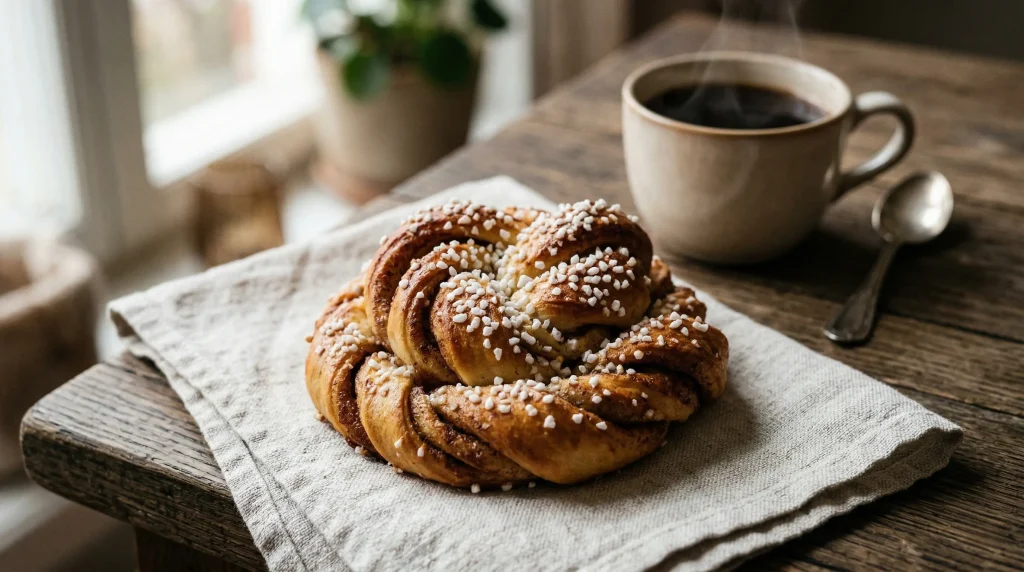
Forget everything you think you know about cinnamon rolls. No thick frosting. No spiral the size of a dinner plate. No sticky glaze pooling on the bottom of a takeout box. The Swedish kanelbulle is a different creature entirely — smaller, spicier, more aromatic, and twisted into a knot that looks almost architectural. Once you’ve had one, the frosted version starts to feel like a rough draft.
Sweden takes the kanelbulle so seriously that October 4th is officially Kanelbullens dag — National Cinnamon Bun Day. Bakeries sell thousands of them. Coffee cups appear from every cupboard in the country. It is a national institution, observed with genuine enthusiasm and zero irony. You do not skip Kanelbullens dag in Sweden. You simply don’t.
What Makes Swedish Cinnamon Buns Different?
The secret lives in two places: the dough and the shape. Ground cardamom goes directly into the dough itself — not just the filling — which means every bite carries that bright, floral spice from the inside out. The buns are then twisted or knotted rather than sliced into spirals, giving them a layered, almost laminated pull when you tear one apart. The topping is pärlsocker, pearl sugar, which stays crunchy through the whole bake and gives each bun a satisfying, slightly dramatic crunch on the very first bite.
This is a bun with personality. Less sweet than its American cousin, more complex, more aromatic — and honestly, more interesting. The cardamom is completely non-negotiable. Many recipes use too little of it. Don’t make that mistake.
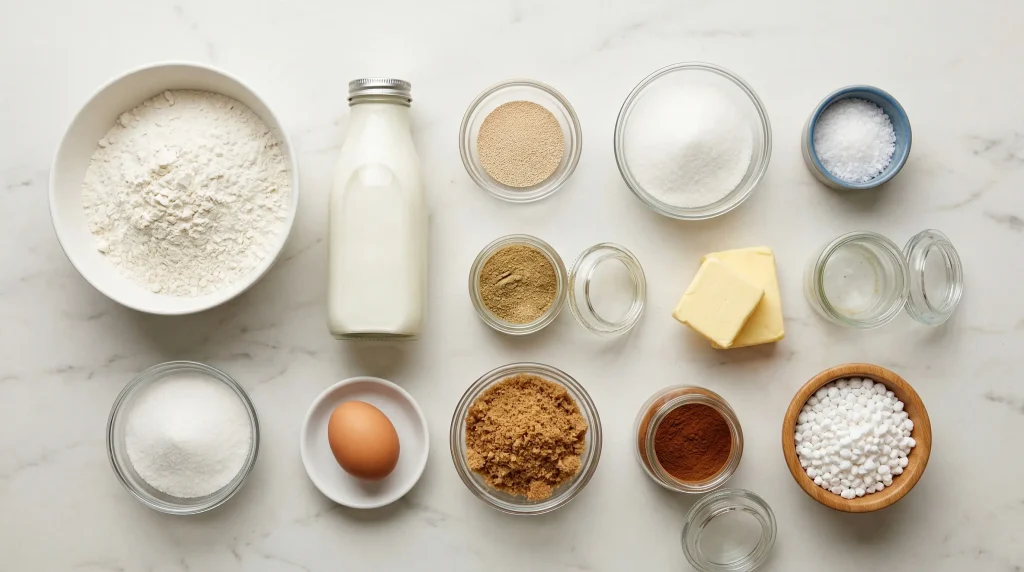
What You Will Need for Swedish Cinnamon Buns
- All-purpose flour — The structural backbone of the dough. Unbleached all-purpose gives the best tender crumb. Bread flour works too, for a slightly chewier result.
- Whole milk — Full-fat milk makes the dough richer and more tender. Warm it gently to 110°F / 43°C — too hot kills the yeast, too cold barely wakes it up.
- Active dry yeast — The leavening that makes everything rise. Instant yeast works equally well and can be mixed directly into the flour without proofing.
- Granulated sugar — A small amount goes into the dough for sweetness and to help activate the yeast. More goes into the filling.
- Salt — Don’t skip this. Salt sharpens every other flavor and keeps the dough from tasting flat and forgettable.
- Ground cardamom — The defining spice of Scandinavian baking. Freshly ground from whole pods is noticeably more fragrant, but good-quality pre-ground is perfectly fine.
- Unsalted butter — Used in both the dough and the filling. Softened for the filling so it spreads smoothly; worked into the dough for richness and a tender crumb.
- Egg — Enriches the dough and gives it a soft, golden interior. Use a room-temperature egg for the best incorporation.
- Brown sugar — For the filling. It brings a gentle molasses depth that white sugar simply can’t match.
- Ground cinnamon — The star of the filling. Use a good-quality, fragrant cinnamon — it matters more here than in almost any other recipe.
- Pearl sugar (pärlsocker) — The classic topping, providing a satisfying crunch and that unmistakably Nordic finish. Find it at Scandinavian or European specialty stores, or easily online. Coarse turbinado sugar is a decent substitute in a pinch.
- Egg wash — One egg beaten with a tablespoon of milk, brushed on just before baking for a glossy, deep-golden crust.
Shaping Swedish Cinnamon Buns — Easier Than It Looks
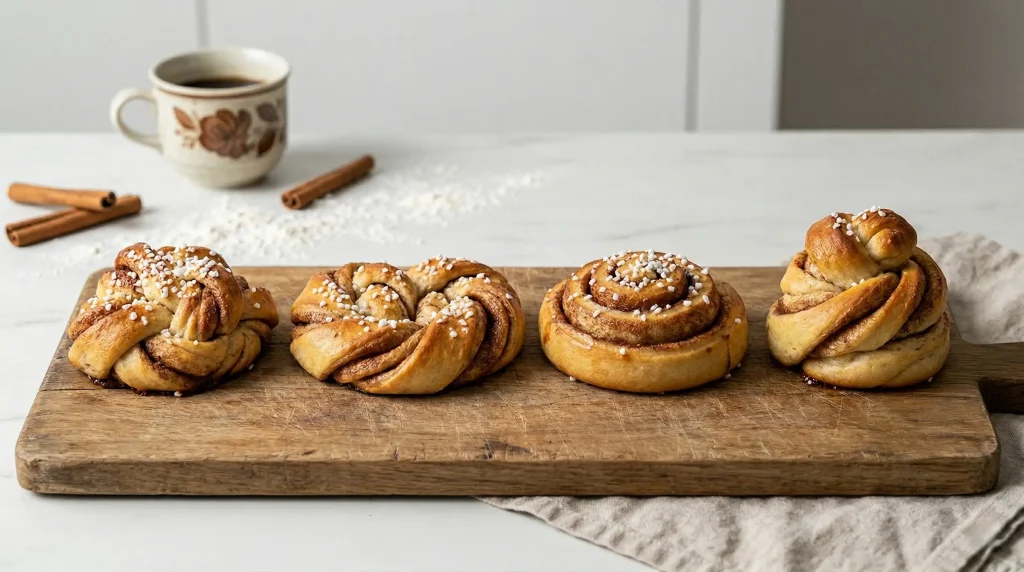
Here is where people overthink things — and also where things get genuinely fun. There is no single correct shape for a kanelbulle. Swedish bakeries and home bakers have been happily arguing about this for generations, and the result is a wonderful variety of forms. The most common are:
- The knot — fold the dough, cut into strips, twist each strip firmly, coil it around two fingers, and tuck the end underneath. Layered, dramatic, and satisfying to make.
- The snail (snäcka) — roll the filled dough into a tight log, then slice it into rounds like a classic cinnamon roll. Simpler, tidier, and equally delicious.
- The twist — twist a strip a few times and simply lay it flat on the tray. Rustic, quick, and unpretentious. Nobody is judging.
- The standing knot — like the coiled knot, but stood upright on the baking sheet so the layers splay open like a flower in the oven.
Pick whichever shape fits your mood or your patience level that day. And if you want to go deeper — Swedish baker Camilla Hamid demonstrates seven different shaping techniques in the video below. It’s in Swedish, but the hands do all the talking. Watch it once and you’ll wonder why you were ever intimidated.
Your buns will look slightly rustic and handmade regardless — and that is correct. Nobody in a Swedish bakery is standing over a ruler. A too-perfect kanelbulle lacks character, and a little imperfection bakes out beautifully. Let them be themselves.
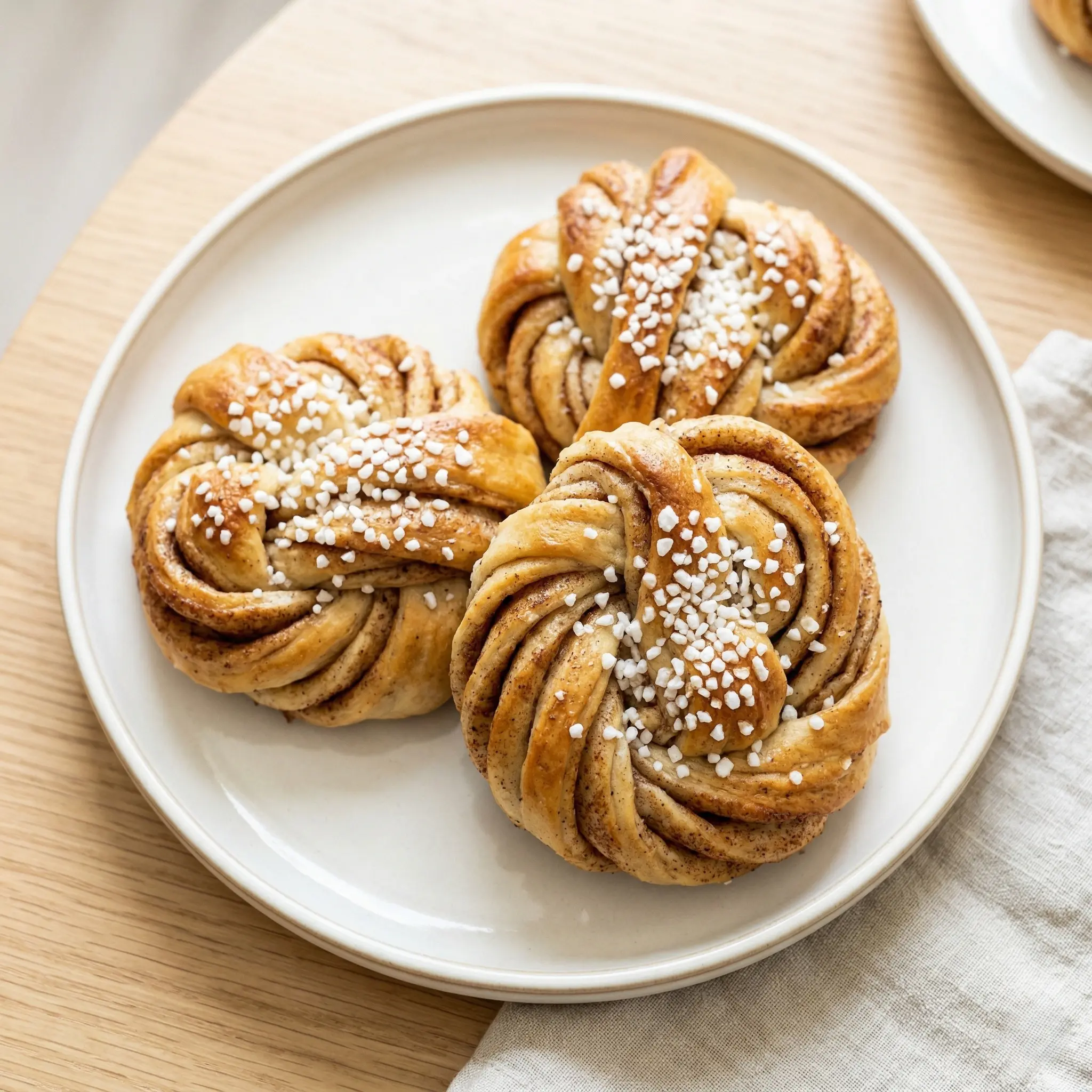
Easy Swedish Cinnamon Buns (Kanelbullar) – Step-by-Step
Ingredients
Method
- Proof the yeast. Combine warm milk, 1 tsp of the granulated sugar, and yeast in a small bowl. Stir gently and let sit 5–10 minutes until foamy. If nothing happens after 10 minutes, your yeast is likely expired — start with a fresh packet.
- Make the dough. In a large bowl or the bowl of a stand mixer fitted with a dough hook, whisk together flour, remaining sugar, salt, and cardamom. Add the yeast mixture and egg. Mix until a rough dough forms, then add softened butter in small pieces while kneading. Knead for 8–10 minutes until the dough is smooth, elastic, and slightly tacky but not sticky.
- First rise. Shape the dough into a ball and place in a lightly greased bowl. Cover with a clean kitchen towel or plastic wrap. Let rise in a warm, draft-free spot for 60 minutes, or until doubled in size.
- Make the filling. Beat softened butter, brown sugar, cinnamon, and cardamom together until a smooth, spreadable paste forms. Set aside at room temperature.
- Roll out the dough. Punch down the risen dough and turn out onto a lightly floured surface. Roll into a rectangle approximately 16 × 12 inches (40 × 30 cm). Spread the cinnamon filling evenly across the entire surface, all the way to the edges.
- Fold and cut. Fold the dough in half lengthwise, bringing the top edge down to meet the bottom. Press gently to seal. Using a sharp knife or bench scraper, cut into strips approximately 1 inch (2.5 cm) wide — you should get 16–18 strips.
- Shape the buns. Hold each strip at both ends and twist in opposite directions 3–4 times. Coil the twisted strip around two fingers, overlapping the layers, then tuck the loose end firmly underneath. Place on parchment-lined baking sheets, spacing buns about 2 inches (5 cm) apart.
- Second rise. Cover the baking sheets loosely with a kitchen towel. Let the shaped buns rest 30–45 minutes until visibly puffed.
- Preheat the oven to 400°F (200°C) conventional, or 375°F (190°C) for fan/convection.
- Egg wash and sugar. Brush each bun gently with egg wash. Scatter pearl sugar generously over the tops.
- Bake for 12–15 minutes until deep golden brown. Watch closely after the 12-minute mark — they color fast.
- Cool and serve. Transfer to a wire rack and rest for at least 10 minutes. Serve warm alongside strong black coffee. Store in an airtight container at room temperature for up to 2 days.
Notes
- Make-ahead: Shape the buns, cover tightly, and refrigerate overnight before the second rise. In the morning, let them sit at room temperature 30–45 minutes before baking.
- Freezing: Bake fully, cool completely, then freeze in an airtight bag for up to 2 months. Reheat at 325°F (165°C) for 8–10 minutes straight from frozen.
FAQ & Troubleshooting
The most common cause is milk that was too hot — above 120°F / 49°C kills the yeast instantly. Always proof your yeast first. No foam after 10 minutes means expired yeast; replace it before you go any further.
Yes — same amount, and skip the proofing step entirely. Mix instant yeast directly into the dry ingredients and proceed as written.
Over-kneading or over-baking are usually the culprits. The finished dough should feel soft and slightly tacky. In the oven, pull them as soon as they hit deep golden — 12–15 minutes is genuinely all they need.
Your filling butter was likely too warm, or even slightly melted. It should be softened but firm enough to hold its shape. A hot oven also helps set the buns before the filling has time to escape.
Coarse turbinado or raw sugar is a solid substitute. Avoid regular fine granulated sugar — it dissolves completely in the oven and disappears, leaving a perfectly baked but sadly bare bun.
Absolutely. Knead on a lightly floured surface for 10–12 minutes. The dough is ready when it passes the windowpane test — stretch a small piece gently and it should turn thin and translucent without tearing.
Tuck that loose end firmly under the coil before placing the buns down. Chilling the shaped buns for 10 minutes before the second rise also helps them hold their form through the bake.