
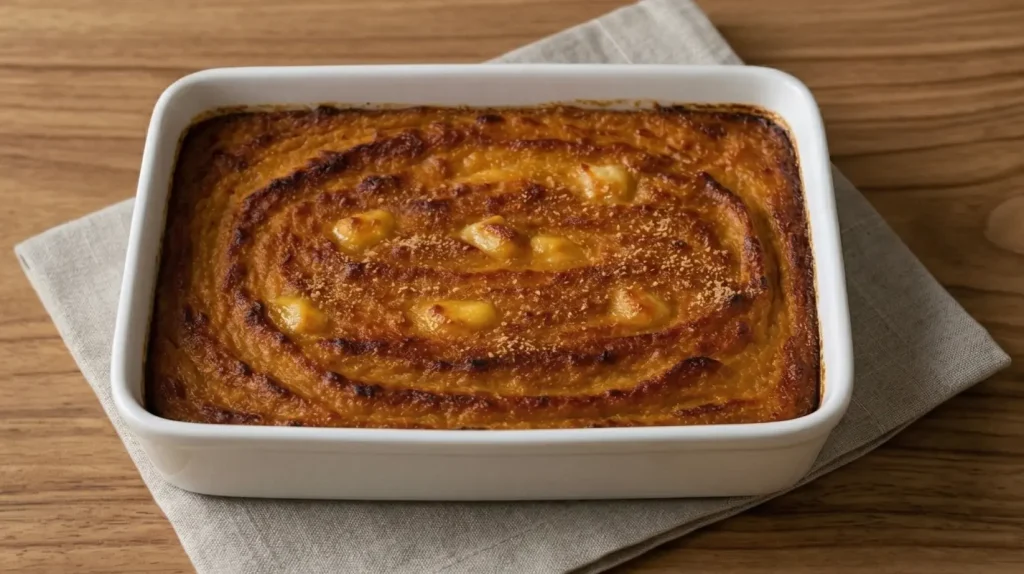
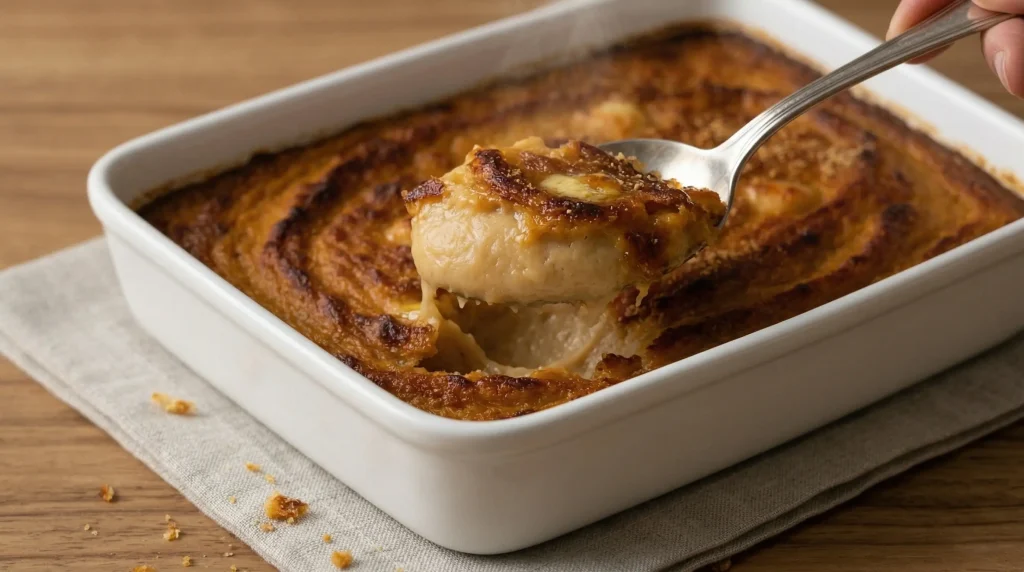
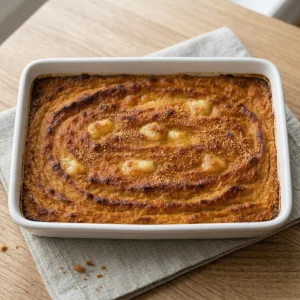
There’s a dish on the Finnish Christmas table that looks, at first glance, exactly like mashed potatoes that got a little ambitious. It’s golden on top, creamy inside, faintly caramelized around the edges — and sweet. Naturally, inexplicably, no-sugar-in-sight sweet. People take a bite and then look at the serving dish with narrowed eyes, trying to work out what happened.
That dish is imelletty perunalaatikko — Finnish sweetened potato casserole — and it may be the most quietly extraordinary side dish in all of Nordic cooking.
What Is Imelletty Perunalaatikko?
The name breaks down with that satisfying Finnish directness: imelletty comes from the verb imellyttää, meaning to sweeten, and perunalaatikko means potato casserole. So yes — you’re making a sweetened potato box, which sounds exactly as cozy as it tastes.
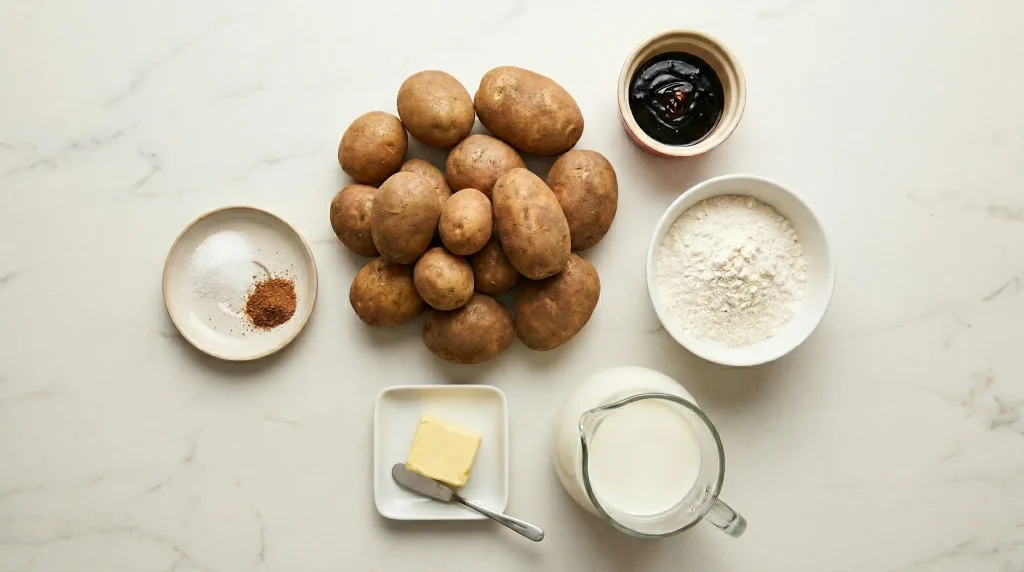
Imelletty perunalaatikko is a traditional Finnish baked casserole tracing its roots to the Päijät-Häme region of southern Finland. It’s built from the simplest pantry staples — starchy potatoes, wheat flour, whole milk, butter, and a thin drizzle of dark syrup — yet its defining quality is achieved before a single one of those extra ingredients has been added. The sweetness doesn’t come from the syrup. It comes from the potato itself, coaxed out through a slow enzymatic process that Finnish home cooks have been quietly relying on for generations.
The result is a casserole that sits somewhere between a creamy potato gratin and a savory baked sweet potato dish — golden-crusted, deeply potatoey, and gently sweet in a way that feels less like dessert and more like discovery. Once you’ve tasted it, plain mashed potato feels like a rough draft.
The Science of Sweetening (It’s Genuinely Wonderful)
Here’s where this dish becomes something you’ll want to explain to everyone at the table, preferably while ladling out second helpings.
When you mash hot, cooked potatoes and immediately stir in wheat flour, you’re introducing amylase — an enzyme naturally present in wheat — into a warm, starch-rich environment that it finds extremely motivating. Held at around 122–140°F (50–60°C) for several hours, the amylase slowly breaks the potato’s complex starches down into shorter carbohydrate chains: sugars. No fermentation, no special equipment, no tricks. Just an enzyme doing exactly what it was born to do.
The temperature window is non-negotiable. Below 122°F (50°C), the enzymes aren’t active enough to make a meaningful difference. Above 167°F (75°C), they break down entirely and the sweetening stops — permanently. Your working range is warm, gentle, and patient, which describes most of the best things in Finnish cooking.
It’s the same class of enzymatic reaction that makes malted barley sweet in brewing, and it is fascinating every single time.
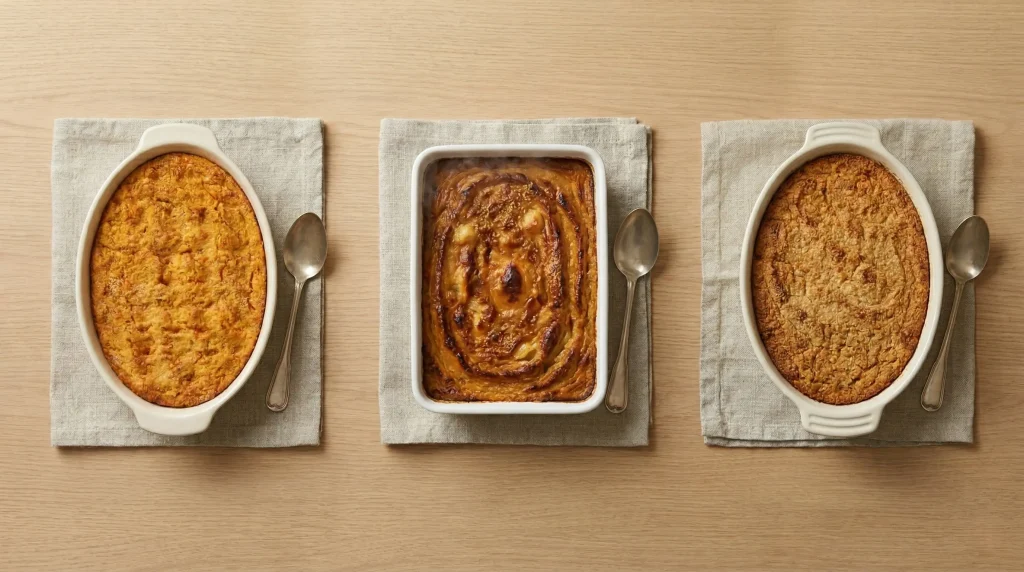
Part of Finland’s Three-Casserole Christmas
Imelletty perunalaatikko doesn’t arrive alone. It’s one of three beloved casseroles that have anchored the joulupöytä — the Finnish Christmas table — for generations, sitting alongside porkkanalaatikko (carrot casserole, eggy and sweet with a crisp breadcrumb top) and lanttulaatikko (our rutabaga casserole, warmly spiced and deeply golden).
Together, these three form a side dish lineup that is entirely vegetarian, deeply satisfying, and utterly unlike anything else in Nordic food culture. Each has its own personality: lanttulaatikko is assertive and spiced; porkkanalaatikko is light and golden-sweet; imelletty perunalaatikko is the quiet one — soft, creamy, and subtly complex. It’s the kind of dish that doesn’t shout for attention but earns every plate that comes back for more.
Classically, all three sit alongside a magnificent Christmas ham. But honestly? This casserole is far too good to reserve for one month of the year.
Before You Start: A Few Tips
Choose the right potato. Russet or Idaho potatoes are ideal — floury, high-starch, and they mash to a smooth, lump-free purée without complaint. Waxy salad potatoes won’t give you the texture you need, and the enzymatic process will be less effective with lower-starch varieties.
Plan for the long game. The sweetening stage takes 4–6 hours and cannot be rushed — the chemistry simply doesn’t work on a deadline. Make this a weekend project: boil and mix in the morning, sweeten through the afternoon, bake for dinner. Or do the sweetening overnight and bake the next day.
Use your oven for warmth. Set it to its lowest possible temperature — ideally 140–150°F (60–65°C) — and place the covered mash inside. This is the most reliable way to hold the right temperature without monitoring. If your oven doesn’t go that low, the “keep warm” setting or even the oven with just the light on (which holds around 85–95°F) will work for an overnight sweetening of 10–12 hours.
Dark syrup is the real thing. Traditional Finnish tumma siirappi is a dark, molasses-style syrup made from sugarcane, with a deep, rounded sweetness. Unsulphured molasses is the closest widely available substitute — slightly more assertive, but excellent. Start with one tablespoon; taste before baking and add a second if you want more depth.
What You Will Need
You’ll need a large pot for boiling the potatoes and a sturdy potato masher. For truly silky results, consider a potato ricer — it’s worth every penny for this recipe. Keep a ladle handy to scoop out the precious starchy cooking water before draining. Don’t skip that step — it’s your secret consistency tool later on.
For the sweetening and baking stages, use a large oven-safe pot or deep baking dish. A tight-fitting lid or foil is essential to hold warmth in without drying the mash out. An oven thermometer is quietly important here. Your oven’s lowest setting needs to hover between 140–150°F (60–65°C). Many ovens run hotter than they claim, so always verify the temperature. For the final bake, a 9×13-inch (23×33 cm) baking dish is the right size. Ceramic or enamel both work beautifully and go straight from oven to table.
The Sous-Vide Method: For the Perfectionists Among Us
If you’ve read the science section above and thought I want to nail this with absolute certainty, a sous-vide immersion circulator is your answer — and it changes the game completely. Here’s the honest truth about the traditional oven method: domestic ovens are surprisingly bad at holding a steady low temperature. The heating element cycles on and off in waves, and during a hot cycle your oven can briefly spike to 167°F (75°C) or above — the exact threshold at which the β-amylase enzyme permanently denatures and all maltose production stops.
When that happens, the mash can become watery (thanks to the more heat-resilient α-amylase still doing its job) but inexplicably sweet-less, which is arguably the saddest possible outcome. A sous-vide water bath, by contrast, holds a precise 140°F / 60°C to within a fraction of a degree for as long as you need — placing it squarely in the sweet spot where both enzymes work together at full efficiency, with zero risk of overheating.
To do the sweetening stage sous-vide:
- Boil your potatoes unpeeled in unsalted water — the skins help prevent them from absorbing excess liquid. Peel and rice or mash them while still hot.
- Monitor the temperature. Don’t add the flour until the mash has cooled to between 149–158°F (65–70°C). Use a digital probe thermometer — this step matters more than any other.
- Add the flour and mix thoroughly, folding it evenly through the entire mass.
- Transfer to a large, heavy-duty zip-top freezer bag — double-bag it for insurance. Leave a small gap at one corner and slowly lower the bag into your pre-set water bath. As the bag descends, the water pressure pushes out all the trapped air through that tiny opening; just before the waterline reaches the gap, seal it shut. This is the water displacement method, and it works beautifully without any special equipment. Weigh the bag down with a plate or heavy object to keep it fully submerged.
- Incubate at 140°F (60°C) for 4–8 hours. The mash will visibly transform from a stiff purée into something almost soupy and loose — that liquefaction is the α-amylase doing its structural work, and it is exactly what you want to see.
- When done, decant into a bowl. Taste it. It should be remarkably, almost startlingly sweet — clean and malty, with none of the vegetal starchiness you started with. Proceed with adding the scalded milk, butter, syrup, and salt as in the main recipe, then bake as directed. One critical note: fill your baking dish no more than halfway. The high concentration of natural sugars and dairy will bubble aggressively in the oven, and an overfilled dish will boil over with spectacular and very messy results.
A successful sous-vide imelletty perunalaatikko will need significantly less dark syrup — perhaps none at all — because the enzymatic sweetening will have done everything it was supposed to. That quiet, malty depth is the authentic flavor this dish was always meant to have.
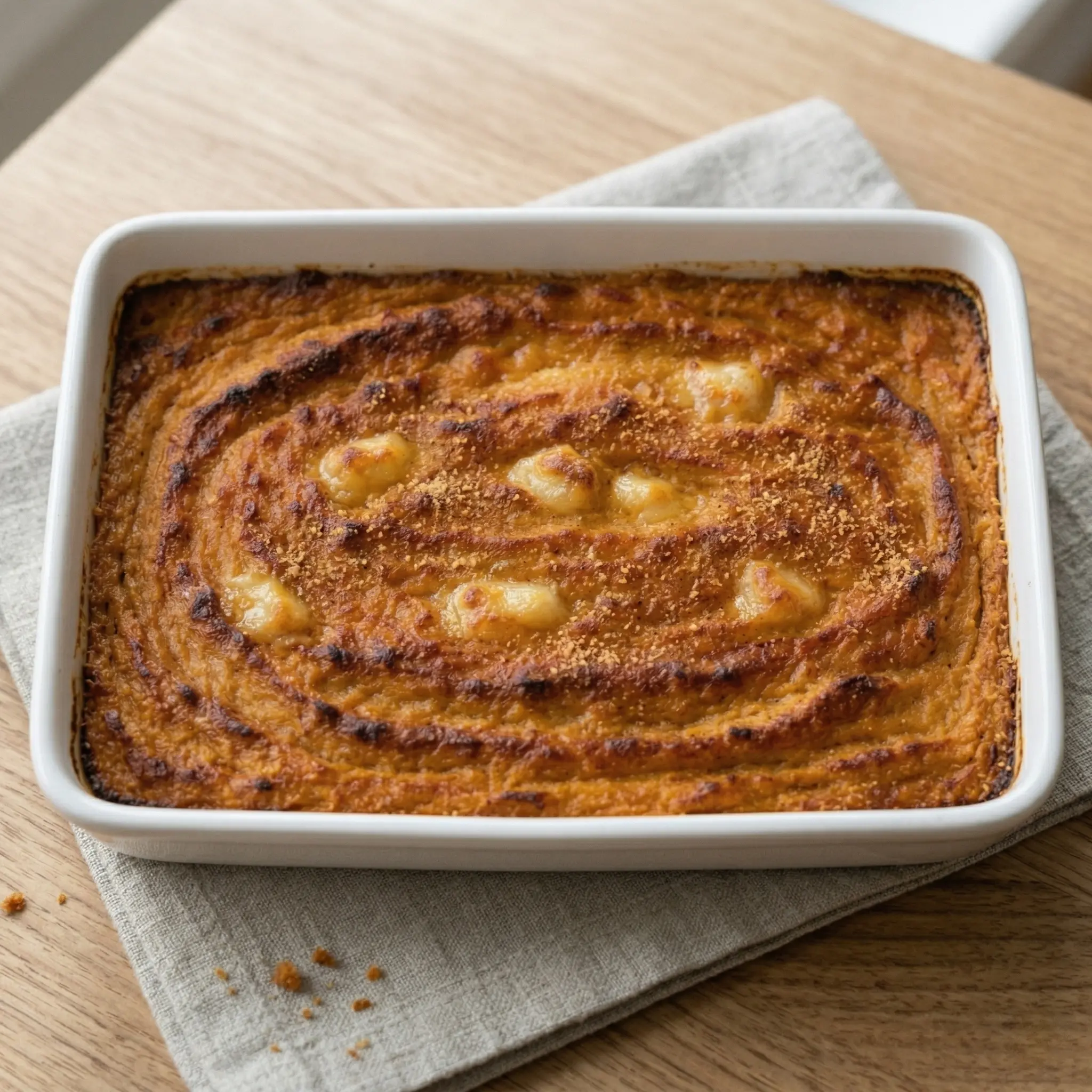
Imelletty Perunalaatikko – Finnish Sweetened Potato Casserole
Ingredients
Method
- Peel the potatoes and cut into chunks of roughly equal size.
- Place in a large pot, cover with unsalted water and boil until very tender.
- Drain well, reserving a little of the cooking water if you like for adjusting consistency.
- Mash until completely smooth – a potato ricer is ideal for a silky casserole.
- You want a soft mash, but not too runny. Add a splash of the cooking water if it seems dry.
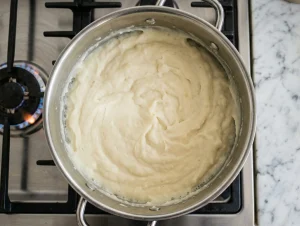
- Let the mash cool down a little until it’s warm but not hot – ideally around 50 °C / 122 °F.
- Stir in half of the flour (1 dl) and about half of the butter, cut into small pieces.
- Mix thoroughly, then sprinkle the remaining flour on top of the mash without stirring it in completely – this gives the enzymes a good contact layer.
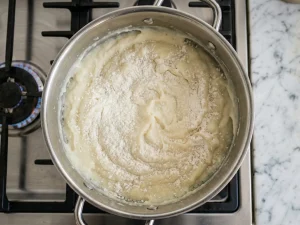
- Cover the pot with a lid.
- Keep the mash warm (roughly 50–65 °C / 122–149 °F) for 4–8 hours.
- If you have a thermometer, check occasionally to make sure it doesn’t climb much above 70 °C / 158 °F.
- Over time, the mash will become looser and noticeably sweeter and more mellow in flavour. The top may darken slightly where the flour sat – that’s normal.

- Once you’re happy with the sweetness, stir the mash thoroughly so any flour on top is fully mixed in.
- Warm the milk and melt the rest of the butter.
- Add milk gradually, stirring, until the mash is softer than normal mashed potatoes, but not soupy – think thick cake batter.
- Season with salt and nutmeg/white pepper (if using).
- Taste. If the sweetening hasn’t developed enough, add 1–2 tbsp dark syrup and stir well. The flavour should be gently sweet, not dessert-level sugar bomb.
- Preheat the oven to 150 °C / 300 °F.
- Grease one large or two medium casserole dishes with butter.
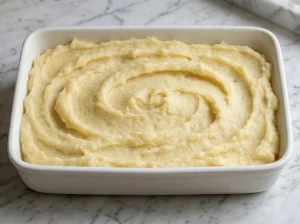
- Pour the potato mixture into the dishes, leaving some headspace – the casserole will bubble and puff a little.
- Dot the surface with a few small bits of butter. You can also draw a simple pattern with a spoon or fork for the classic Finnish look.
- Bake for 2–3 hours, until the top is deep golden brown, the edges have caramelised a bit and the casserole feels set in the centre..
- Let it rest at least 15 minutes before serving so it firms up slightly.
How to Serve Imelletty Perunalaatikko
This casserole was born to sit beside a slow-baked ham — the gentle, caramelized sweetness of the potatoes plays beautifully against rich, salty meat. It’s equally at home alongside roast chicken, beef tenderloin, or any slow-roasted centerpiece that anchors a holiday spread. Add all three Finnish casseroles to the table with a good jar of mustard, and you have a Nordic feast that needs very little else to be complete.
Leftovers are arguably better than the original — the flavors settle and deepen overnight. Reheat covered with foil in a gentle oven, and resist the urge to rush it with a microwave. Some things deserve patience twice.
FAQ & Troubleshooting
Temperature is almost always the answer. If the mash dropped below 122°F (50°C) during the resting stage, the enzymes became inactive. If it exceeded 167°F (75°C) — in an oven that runs hot — the amylase was destroyed before it had time to work. An oven thermometer is your best friend here. Stir once or twice during the sweetening stage to confirm the mash is holding an even, gentle warmth throughout.
Yes — standard unbleached all-purpose wheat flour contains enough natural amylase to do the job effectively. Avoid cornstarch, rice flour, or gluten-free alternatives; they don’t contain the right enzymes and the sweetening will not occur.
Add the warm milk in stages, not all at once. You’re aiming for a texture noticeably looser than mashed potato but thicker than a pourable soup. It will firm up significantly during the long bake, so don’t be tempted to reduce the milk if it seems loose going into the dish.
Absolutely, and it’s actually the smart approach. Complete the sweetening stage, cool slightly, and refrigerate the mash overnight. The enzymatic process continues slowly in the cold, often producing a sweeter result. The next day, stir in the warm milk, season, and bake as directed — fresh from the oven, with zero stress.
That deep, caramelized golden crust is the goal — the natural sugars in the sweetened mash do exactly what sugars do in a hot oven. If it’s coloring faster than you’d like, tent loosely with foil for the last 30 minutes. A very dark top that isn’t burnt is correct and delicious; that’s not a problem, that’s a feature.
Yes. Oat milk is a particularly fitting substitute — it has a gentle natural sweetness that suits the dish and feels right at home in a Nordic kitchen. Use a good-quality dairy-free butter for the topping. The result will be lighter in flavor but still deeply satisfying.