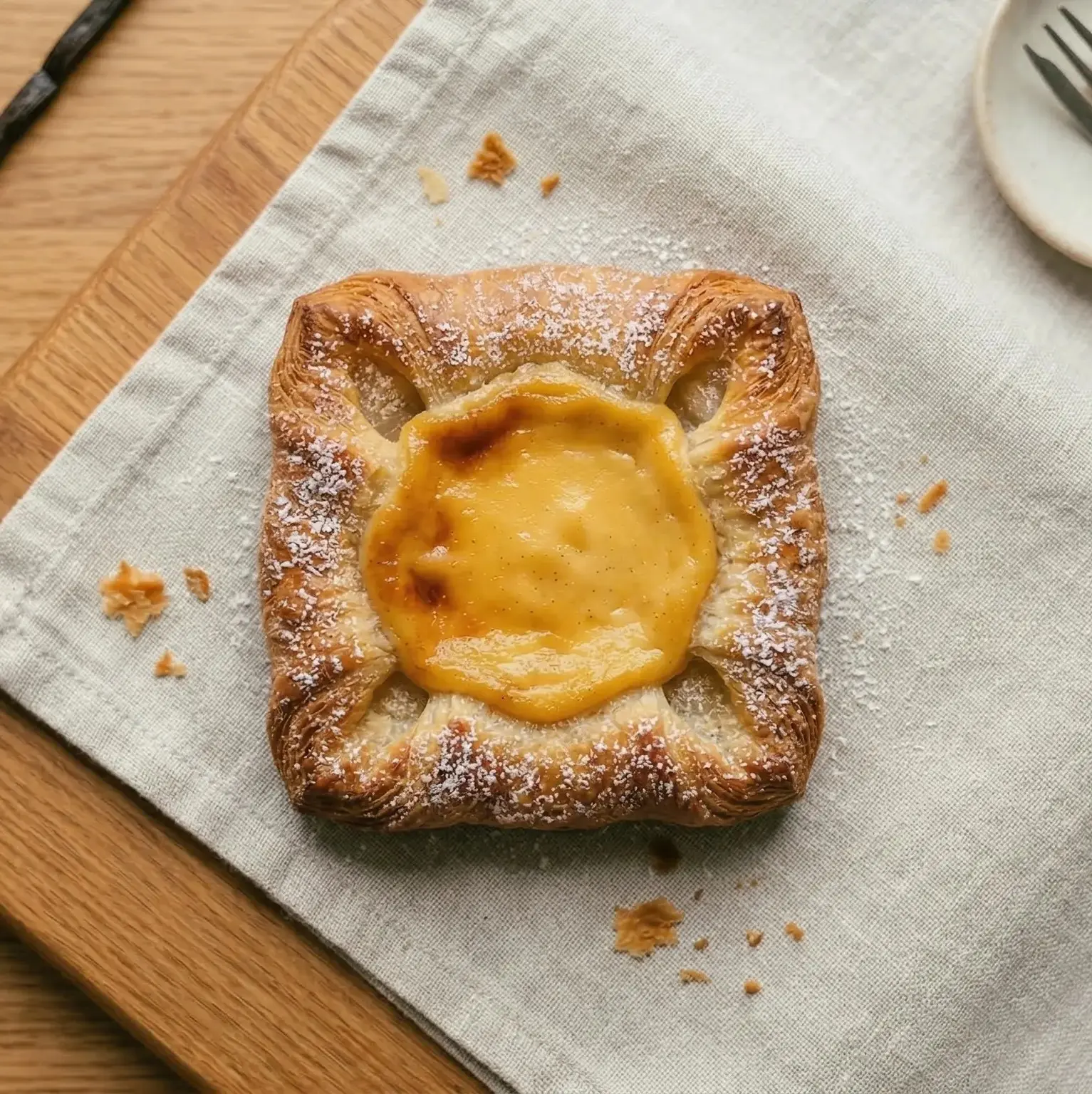
Ingredients
Method
Keep everything cold (core rule): chilled dough + chilled butter + short working bursts.
Use a scale; cups are secondary.
Make the dough
- In a stand mixer bowl (dough hook) or a large mixing bowl, combine flour, sugar, and salt.
- Add the cold eggs and ice-cold water. Mix just until a rough dough forms.
- Add your yeast and mix only until the dough is almost cohesive.
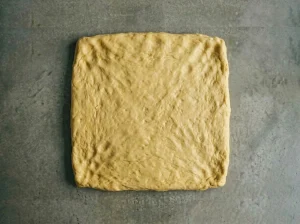
- Pat dough into a thick square (about 1 inch / 2.5 cm thick). Wrap and refrigerate 20–30 minutes.
Make the butter block
- Place cold butter between parchment sheets. Pound/roll into a square about 6×6 inches (15×15 cm).
- Refrigerate 15 minutes so it’s cold but still bendable (not rock-hard).
Lock in the butter
- On a lightly floured counter, roll dough into a square large enough to wrap the butter block (about 9×9 inches / 23×23 cm).
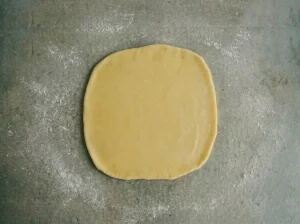
- Place butter in the center.
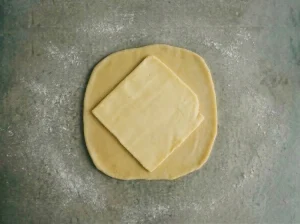
- Fold dough corners over butter to fully encase; pinch seams closed.
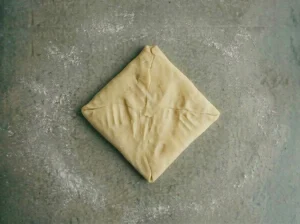
Lamination: 3 single turns = 27 layers
- Turn 1: Roll to a long rectangle (~12×24 inches / 30×60 cm). Brush off flour. Fold into thirds (letter fold). Wrap and chill 15–30 minutes. (Layers: 3)
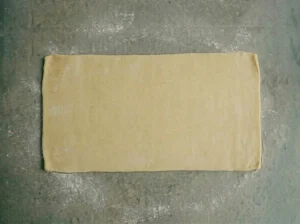
- Turn 2: Rotate 90°. Roll again to ~12×24 inches / 30×60 cm. Letter fold. Chill 15–30 minutes. (Layers: 9)
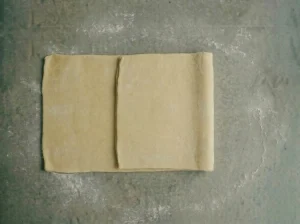
- Turn 3: Rotate 90°. Roll again, letter fold. Chill 30–60 minutes (or overnight). (Layers: 27)
Make the custard
- Heat the milk: In a medium saucepan, bring the milk and the pinch of salt to a gentle simmer over medium heat. Do not let it come to a rolling boil. (Note: If using vanilla bean paste, add it to the milk now. If using vanilla extract, wait until the end).
- Whisk the base: While the milk is heating, whisk the egg yolks, granulated sugar, and cornstarch together in a heat-proof bowl until the mixture becomes smooth, thick, and pale yellow.
- Temper the eggs: Once the milk is simmering, very slowly pour about half of it into the egg yolk mixture while whisking constantly and vigorously. This "tempers" the eggs, bringing their temperature up slowly so they don't scramble.
- Cook until thickened: Pour the tempered egg mixture back into the saucepan with the remaining milk. Place it back over medium heat, whisking constantly. The mixture will begin to thicken. Once you see large bubbles popping at the surface, whisk vigorously for 1 more minute to cook out the raw cornstarch flavor.
- Add vanilla and chill: Remove the pan from the heat and stir in the vanilla extract (if you didn't add paste earlier). Transfer the custard to a clean bowl. Press a piece of plastic wrap directly against the surface of the custard to prevent a rubbery skin from forming. Chill the custard in the fridge until completely cold and firm before spooning onto your pastries.
Make the filling
- Mix almond paste/marzipan, sugar, butter, and a pinch of salt until smooth. (A fork, hand mixer, or food processor all work.) Keep cool room temp—spreadable, not melted.
Roll, cut and shape
- Roll laminated dough to about 1/8 inch (3–4 mm) thick.
- Cut into 4×4 inch (10×10 cm) squares.
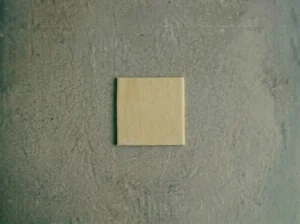
- Place ~1 Tbsp filling in the center of each square.
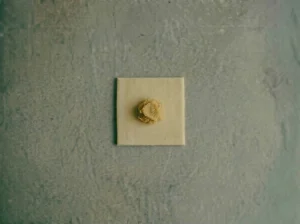
- Fold all four corners toward the center to form an “envelope.” Press to secure.
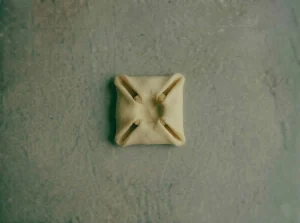
- Place on parchment-lined baking sheets with space between pieces.
Proof
- Proof at 75–80°F (24–27°C) until puffy and slightly jiggly, typically 60–90 minutes.
Finish and bake
- Preheat oven to 375°F (190°C) (or 350°F / 175°C convection).
- Whisk egg + water + salt. Brush lightly on pastries.
- Add the Custard: Spoon about 1 Tbsp of the chilled vanilla custard in the center of the "envelope".
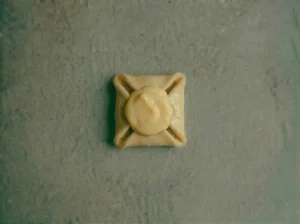
- Optional: sprinkle with slivered almonds.
- Bake 18–22 minutes until deep golden and cooked through.
Glaze (optional)
- Cool 10–15 minutes. Mix confectioners’ sugar with enough water (or milk) to drizzle. Spoon or pipe over pastries.