
Ingredients
Method
Prepare Salmon
- Check the salmon fillet for any pin bones and remove them.
- Pat the salmon dry with paper towels.
- If you have one large piece that is very thick, you may cut it in half crosswise to make two more equal smaller fillets (this helps the cure penetrate evenly). Leave the skin on.
Mix Cure
- In a bowl, combine the salt, sugar, crushed peppercorns, and crushed juniper berries.
- Mix well to create the curing mixture.
Set up Curing Package
- Lay out a large piece of plastic wrap.
- Spread half of the salt-sugar cure mixture on the center of the plastic wrap.
- Place one half of the dill fronds on top of the cure mix.
- Place the salmon fillet(s) on the bed of dill and cure (skin side down if one piece).
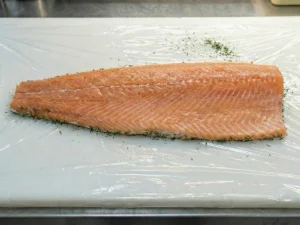
- Pour the gin evenly over the salmon flesh, letting it soak in.
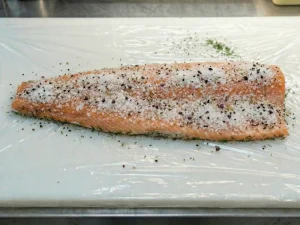
- Then spread the remaining salt-sugar mixture on top of the salmon, covering it thoroughly.
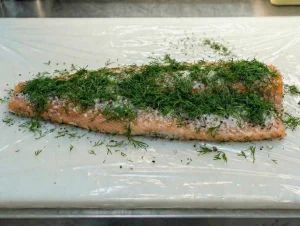
- Lay the rest of the dill fronds over the fish.
Wrap and Weight
- Tightly wrap the salmon in the plastic wrap, making sure the cure and dill are pressed against all sides of the fish.
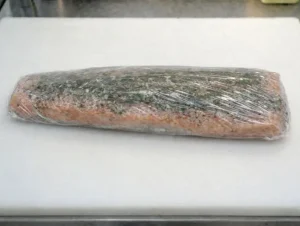
- Place the wrapped salmon in a rimmed dish or baking pan (to catch any leaks).
- Set a weight on top – for example, a cast-iron skillet, a brick wrapped in foil, or a couple of canned goods.
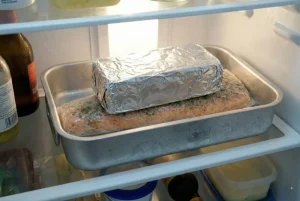
- This pressing helps firm up the gravlax.
Cure in Refrigerator
- Refrigerate the weighted salmon for 48 hours (2 days). For a lighter cure, you can do 24–36 hours; for a very firm, “hard” cure, go up to 72 hours.
- Flip the package every 12–24 hours so the fish cures evenly in its brine.
- You’ll notice liquid pooling; that’s normal as the salt draws out moisture.
- Optionally, once per day you can briefly open the wrap and sprinkle an extra tablespoon of gin over the fish for extra flavor, then rewrap.
Unwrap and Clean
- After the curing time is complete, remove the salmon from the fridge.
- Unwrap it and discard the dill and curing spices.
- Rinse the salmon under cold running water to wash off the salt/sugar brine. (If you did a mid-cure re-wrap and there isn’t much clinging cure, you can simply wipe the salmon with a damp cloth instead of rinsing, to preserve a bit more flavor – up to you.)
- Pat the salmon very dry with paper towels.
Slice and Serve
- Place the gravlax skin-side down on a cutting board.
- Using a very sharp long knife, slice the salmon thinly.
- For traditional gravlax slices, hold your knife at a shallow angle and cut long, thin slices away from your body, almost parallel to the cutting board.
- Aim for slices about 1/8-inch thick or even thinner.
- The slices will have a translucent orange-pink hue.
- You can slice off and discard the thin grayish surface layer on the very outside if it’s extra salty.
- Arrange the slices on a platter or plate.
- Serve chilled or at cool room temperature with your choice of accompaniments.
Notes
- Safety First: If using wild salmon that hasn't been commercially flash-frozen, freeze it at -4 °F (-20 °C) for at least 7 days before curing to eliminate parasites.