
A country-by-country guide to the food, rituals, and table traditions of the Nordic Christmas Eve.
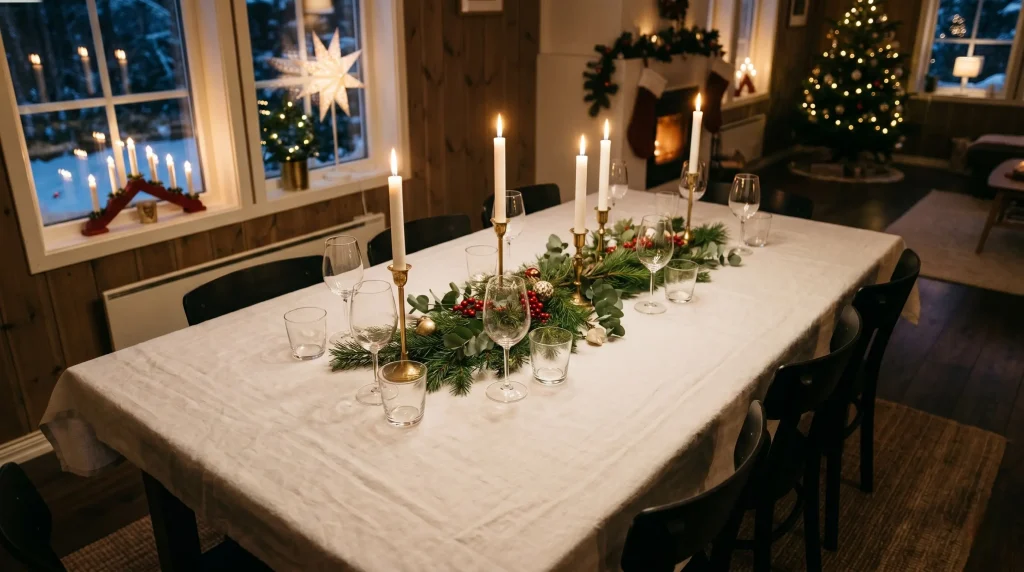
Christmas in the Nordic countries is, above all else, a food event. Not in the casual, festive-season way that applies everywhere in December — but with a degree of cultural seriousness that would surprise anyone who encounters it for the first time. The dishes have names that children learn before they can read. The order of the courses is non-negotiable. And the dinner itself, in most Nordic homes, is the single most important meal of the entire year.
What makes it interesting is that each country does it differently. The shared foundation — a cold fish course, hot meat dishes, rice pudding with a hidden almond, an aquavit glass that never stays full for long — holds across all four countries. But the specifics diverge in ways that reflect each nation’s distinct relationship with its landscape, livestock, and history.
Christmas Eve: When It Happens
Before the food, the timing. Across all four Nordic countries, Christmas Eve (December 24th) is the main event — not Christmas Day. Gifts, dinner, and family all happen on the evening of the 24th. Christmas Day is for recovering.
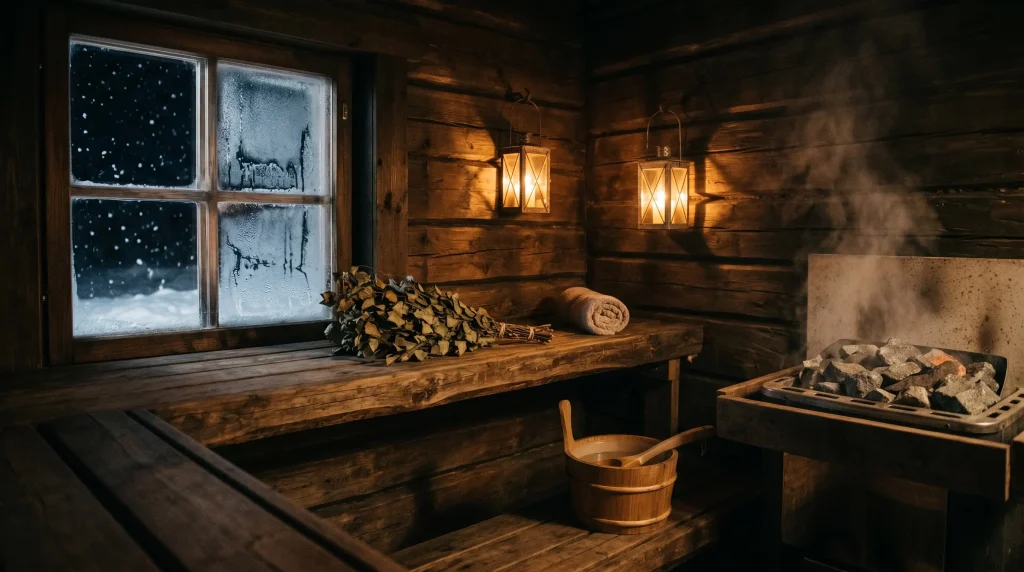
In Sweden, the evening traditionally begins at 3pm with Kalle Anka — a hour-long broadcast of Donald Duck cartoons that has aired every year since 1960 and commands viewing figures that baffle the rest of the world. The dinner follows. In Finland and Norway, the day often starts with a sauna — joulusauna in Finnish — before the family gathers at the table. In Denmark, the tree is lit, the family circles it singing carols, and then everyone sits down to eat.
The rituals differ. The intention is the same.
Sweden: The Julbord
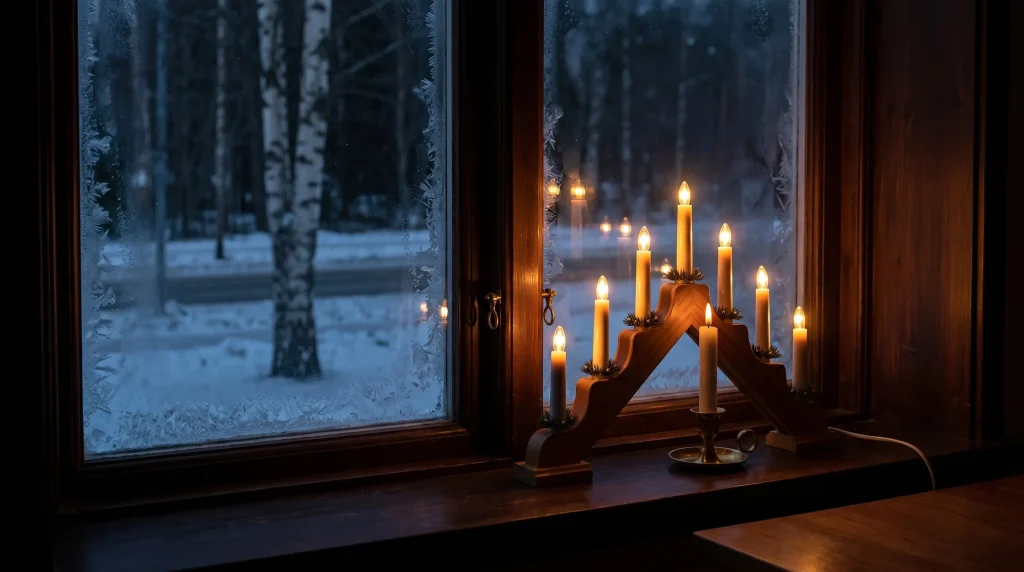
The Swedish Christmas table — julbord — is the smörgåsbord at its fullest and most ceremonial. Everything you know from the smörgåsbord guide applies here, but amplified: more dishes, better aquavit, candles everywhere, and a dinner that can run four to five hours without anyone objecting.
The Dishes
The julbord moves through the same rounds as a classic smörgåsbord — cold fish, then cold cuts and pâté, then hot dishes — but certain items belong specifically and exclusively to Christmas:
Julskinka — the Christmas ham — is the undisputed centerpiece. A whole leg of pork is boiled for hours, then glazed with a mixture of mustard, egg, and breadcrumbs and browned in the oven until the crust turns deep amber. It’s served cold or warm, sliced thick, with senap (mustard) alongside. Every Swedish family has an opinion on the glaze ratio.
Dopp i grytan — literally “dip in the pot” — is one of the oldest Christmas traditions in Sweden, dating back centuries. The broth left over from boiling the julskinka is kept warm, and everyone dips pieces of dark rye bread into it before the meal begins properly. It’s humble, deeply savoury, and completely unlike anything served at any other time of year.
Jansson’s Temptation (Janssons frestelse) — layers of julienned potato, onion, and Swedish ansjovis baked in cream until golden and bubbling — is the hot dish that perhaps most defines the Swedish julbord. It belongs to no other season as fully as it belongs to Christmas. Note that Swedish ansjovis is not the same as Mediterranean anchovies: it’s a sprat cured in a sweet brine, far milder and more delicate, and it’s what makes Jansson’s taste the way it does.
Lutfisk — dried whitefish rehydrated in lye, served with white sauce, allspice, and boiled potatoes — divides Swedish Christmas tables as reliably as it divides the broader Nordic world. It’s gelatinous, mild, and aggressively traditional. Younger generations increasingly skip it; older ones consider skipping it an act of cultural betrayal.
Lussekatter — saffron buns shaped in an S-curve — don’t appear on the Christmas dinner table itself, but they dominate December in Swedish homes from St Lucia Day (December 13th) through to Christmas. The smell of saffron and yeast in a Swedish kitchen in December is, for many Swedes, the smell of Christmas.
Julmust — a dark, spiced soft drink made with hops, malt, and spices — outsells Coca-Cola in Sweden during December. It’s non-alcoholic, sweet-bitter, and profoundly regional: Swedes who have moved abroad list it among the things they miss most.
Ris à la Malta — the Swedish rice pudding — ends the julbord. Cooked rice folded with whipped cream and orange, served cold, with one whole almond hidden inside. Whoever finds the almond is said to marry in the coming year. In practice, whoever finds it mostly just looks smug.
Finland: Jouluruoka
Finnish Christmas food shares its DNA with the Swedish julbord but has a distinctly different character — quieter in presentation, more rooted in the land, and built around casseroles that reflect the long Finnish tradition of slow oven cooking.
The Dishes
Joulukinkku — the Finnish Christmas ham — is distinct from its Swedish counterpart in both preparation and appearance. Finnish ham is traditionally harmaasuolattu — grey-salted, dry-cured without nitrates — giving it a characteristic grey-brown colour and a deeper, more austere saltiness than the pinkish Swedish julskinka. Rather than boiling, it is slow-roasted in the oven, often overnight on Christmas Eve (jouluaatto, December 24th), filling the house with the smell of slowly cooking pork through the night. It is then glazed with mustard and breadcrumbs and returned to the oven until golden — and brought to the table to be sliced warm or at room temperature throughout the evening.”
Pickled herring opens the Finnish Christmas table just as it does across the Nordic countries — several varieties, eaten first, with crispbread and boiled potatoes.
Salmon three ways — gravlax (dill-cured), cold-smoked, and warm-smoked — gives the Finnish Christmas fish course a depth and generosity that sets it apart. Having all three on the same table is not unusual; salmon is central to Finnish food culture in a way it is to no other Christmas tradition in the region.
Rosolli — a cold salad of diced boiled beetroot, carrot, potato, and pickled cucumber, folded together with whipped cream — is a fixture on the Finnish Christmas table. The cream binds the salad and softens the sharpness of the beetroot into something mild and gently sweet. Its deep crimson colour makes it one of the most visually striking dishes of the meal, and a clean counterpoint to the richness of the ham and casseroles.
The casseroles are what make the Finnish Christmas table unique. Three baked dishes appear together on virtually every Finnish Christmas table:
- Lanttulaatikko — a swede (rutabaga) casserole, sweetened with golden syrup, creamy and gently spiced. Polarising for non-Finns; essential for everyone else.
- Porkkanalaatikko — a carrot casserole with rice and cream, lightly sweet.
- Perunalaatikko — a potato casserole whose sweetness is not added but coaxed. Through a process called imeltäminen (sweetening), mashed potatoes are held at a specific warm temperature for several hours, allowing enzymes to naturally convert the starch into sugar. The result is gently sweet and deeply savoury — the most approachable of the three casseroles, and the one that surprises people most.
Together these three casseroles represent one of the most distinctive Christmas side dish traditions in the Nordic world — a trio of slow-cooked root vegetables that taste of nothing else and no other time.
Glögi — the Finnish mulled wine, spiced with cardamom, cloves, cinnamon, and sometimes a small pour of vodka or port — is served throughout December but reaches its peak on Christmas Eve, poured into small cups with raisins and blanched almonds at the bottom.
Tähtitortut — star-shaped pastry tarts filled with prune jam, their points folded in to frame the dark filling — are the Finnish Christmas pastry. Every bakery in Finland produces them from December 1st; every home kitchen has its own version. They sit somewhere between a biscuit and a tart, and no Finnish Christmas table is complete without a plate of them alongside the coffee.
Norway: Ribbe and Pinnekjøtt
Norwegian Christmas is the most regionally varied of the four, and Norwegians will argue about it with a conviction that suggests more than food is at stake. The central divide is between the east and west of the country: eastern Norway eats ribbe, western Norway eats pinnekjøtt. Neither side concedes.
The Dishes
Ribbe — slow-roasted pork belly with crackling — is the most common Norwegian Christmas main. The skin must crackle. If it doesn’t crackle, Christmas has failed. Ribbe is served with boiled potatoes, surkål (sweet-sour braised cabbage), and medisterkaker — thick, spiced pork patties fried in butter.
Pinnekjøtt — salted and dried (or smoked) lamb ribs, rehydrated by soaking overnight and then steamed over birch twigs for hours — is the western Norwegian Christmas dish. The birch twigs are not metaphorical: they’re stacked in the bottom of the pot and the meat steams above them, acquiring a faint smokiness from the wood. Served with mashed swede and potatoes, it tastes like a Norwegian winter rendered edible.
Surkål — sweet-sour braised white cabbage, cooked with caraway, vinegar, and a touch of sugar — is the classic accompaniment to ribbe in eastern Norway. It cuts through the fat of the pork belly in exactly the way it’s supposed to.
Rødkål — braised red cabbage with apple, vinegar, and spices — is the Danish-influenced alternative, more common in southern Norway and increasingly appearing on tables across the country alongside or instead of surkål. The two are close cousins but distinct in colour, sweetness, and regional loyalty.
Kålrabistappe — mashed swede (kålrabi), buttery and slightly sweet — is the traditional accompaniment to pinnekjøtt in western Norway, just as surkål belongs with ribbe in the east. The pairing is so established that ordering one without the other would raise eyebrows.
Boiled potatoes appear alongside all of the above. Always.
Syv Slag — No Norwegian Christmas is complete without syv slag — the tradition of baking exactly seven types of Christmas cookies in the weeks leading up to Christmas. Seven is not a minimum or a target — it is the number. Baking fewer signals that you haven’t made enough effort; baking more risks looking like you’re showing off.
Denmark: Juleaften
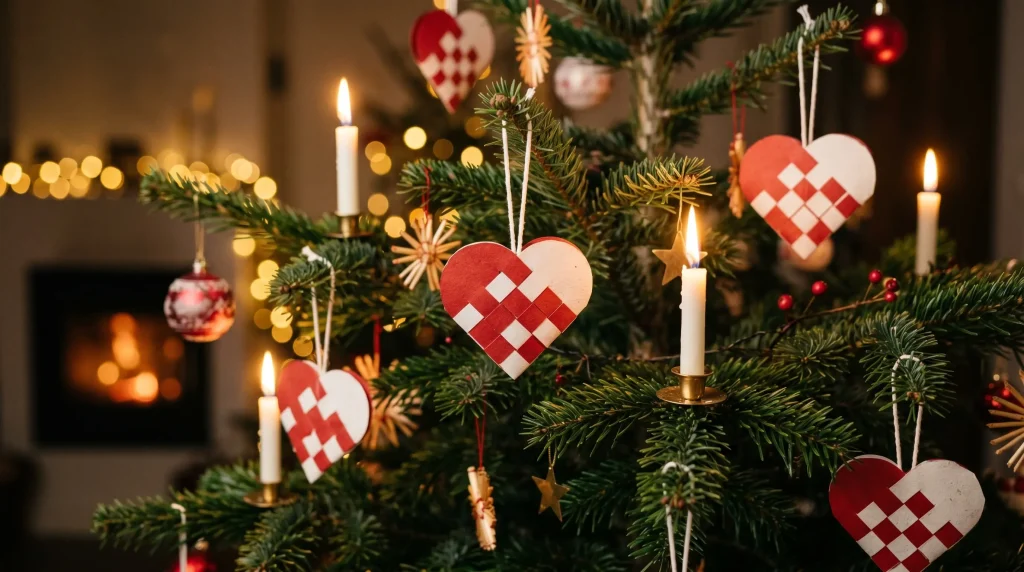
The formal Christmas Eve dinner centres on one of two roasts — and which one depends on the family:
Andesteg — roast duck stuffed with apples and prunes — is the Danish Christmas main, eaten by approximately three out of four Danes on Christmas Eve. The stuffing caramelises inside the cavity during roasting, and the combination of dark duck meat with sweet fruit and sharp rødkål is one of the great flavour pairings of the Nordic Christmas table. Andesteg takes time and attention; it is the choice of households that treat Christmas Eve dinner as the year’s most important meal.
Flæskesteg — roast pork with crackling (svær) — is the alternative for the remaining quarter of Danish households. The cut is typically neck roast (nakkesteg) or loin (kam), both chosen for their generous fat cap, which is scored in a crosshatch pattern before roasting to ensure the skin renders and blisters into proper crackling. The measure of success is identical to Norwegian ribbe: if it crunches, the cook has triumphed; if it doesn’t, no amount of good gravy will save the evening
Rødkål — braised red cabbage with apple, vinegar, and spices, cooked until deep purple and silky — accompanies both roasts and is non-negotiable on the Danish Christmas table.
Brunede kartofler — small potatoes caramelised in sugar and butter — are the side dish that Danish children look forward to most and Danish adults eat too many of every single year without exception.
Risalamande — rich rice pudding with whipped cream, vanilla, and chopped almonds, served with warm cherry sauce — ends the meal. Find the hidden whole almond, win the marzipan pig.
Iceland: Jól
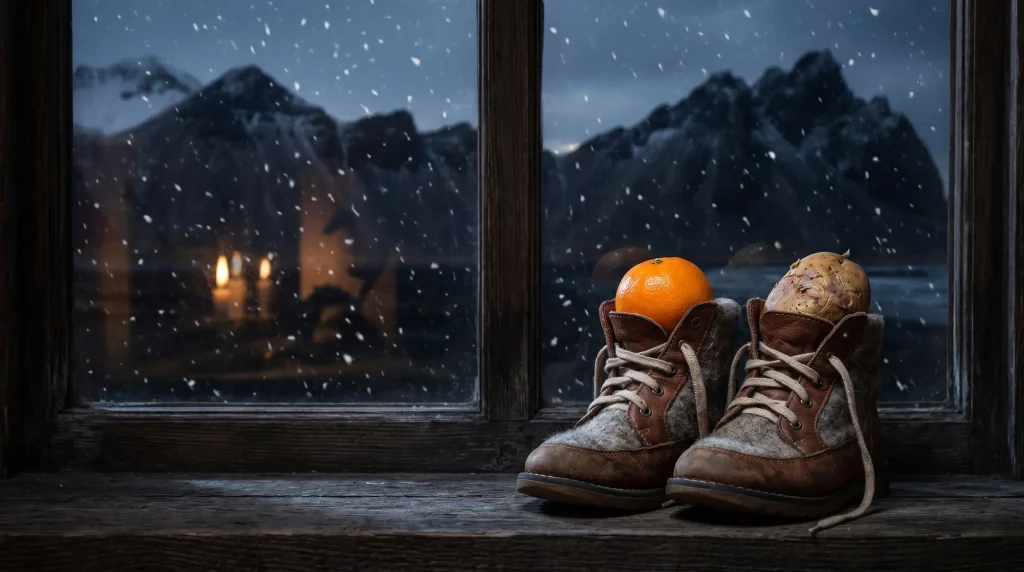
Iceland’s Christmas — Jól — is the most folklore-rich of the Nordic celebrations, shaped by centuries of isolation, a Viking-age relationship with preserved food, and a cast of characters that replaces Santa Claus with thirteen mischievous trolls. The food reflects the same history: resourceful, smoke-seasoned, and unmistakably Icelandic.
The Dishes
Hamborgarhryggur — a glazed rack of cured and smoked pork — is, statistically, the most popular Christmas Eve main in Iceland today, chosen by nearly 50 percent of households on December 24th. Derived from German Kasseler-style meat processing and introduced through Danish influence in the mid-20th century, it is glazed with sugar and mustard, roasted until caramelised, and served with caramelised potatoes and Waldorf salad. Its dominance on Christmas Eve is a relatively recent development, and older generations remain ambivalent about it — but the numbers are clear.
Hangikjöt — literally “hung meat” — is the most culturally resonant dish of the Icelandic Christmas, and it owns Christmas Day. Surveys show 69 percent of Icelanders serve it on December 25th. It is smoked leg of lamb, traditionally preserved using two distinct methods that persist to this day: birkireykt (smoked over native Icelandic birch) and taðreykt (smoked over dried sheep dung mixed with hay). The taðreykt method was born from Iceland’s near-total deforestation after Norse settlement — without timber, Icelanders turned to the only fuel they had in abundance. The dense, cold smoke from dried dung infuses the lamb with a deeply smoky, salty, and slightly sweet flavour entirely unique to the Icelandic terroir. The meat is boiled until tender and served hot with uppstúfur — a thick béchamel-style white sauce with potatoes — alongside canned green peas, pickled red cabbage, and laufabrauð. Served cold, sliced wafer-thin on flatkaka (Icelandic flatbread) or rúgbrauð (dense, dark geothermally-baked rye bread) with butter, it functions as Iceland’s answer to the cured meats of continental Europe.
Rjúpa — rock ptarmigan — is the Christmas alternative for households seeking something from the land rather than the smokehouse. Historically it was the poor man’s Christmas dinner, eaten by those who couldn’t afford to slaughter a lamb. Today the dynamic has completely inverted: strict hunting quotas, a near-threatened conservation status, and a prohibition on commercial sale have made it a genuine luxury, sourced either through personal hunting connections or imported frozen from the UK. The lean, dark, gamey meat is flash-fried in butter and finished in the oven, then served with a rich sauce of cream, game broth, blue cheese, and blackcurrant jelly or rhubarb jam.
Laufabrauð — leaf bread — is one of the most visually distinctive foods in the entire Nordic Christmas tradition. Wafer-thin circles of dough are carved by hand into intricate geometric and floral patterns using a specialised brass roller (laufabrauðsjárn) or a small sharp knife, then deep-fried in hot fat for mere seconds until crisp and pale gold. The bread is pressed flat immediately on removal from the oil to prevent curling. Every family guards its own patterns, passed down through generations; the cutting is a communal activity undertaken in the weeks before Christmas, bringing extended families together around the table. The bread is so thin it was historically said you should be able to read a book through the uncooked dough — a reflection of how precious flour once was on the island, where all grain had to be imported by sea. Beautifully executed pieces are sometimes considered too exquisite to eat and hung in windows as decorations instead.
Möndlugrautur — warm rice porridge with a whole almond hidden inside — is served at midday on Christmas Eve, well before the evening feast. The authentic Icelandic version is topped with ground cinnamon and sugar and a melting pat of butter — not cherry jam, which is the Danish risalamande tradition and a more recent arrival on Icelandic tables. Both versions now coexist in modern Icelandic households, but the indigenous version is firmly the cinnamon-sugar one. The finder of the almond receives a möndlugjöf — traditionally a marzipan pig or a small toy.
Malt og Appelsín — a mixture of Egils Malt (a dark, malty soda originally marketed as a nutritional tonic) and Egils Appelsín (a bright orange soda) — is the Icelandic Christmas drink. Non-alcoholic, deeply seasonal, and inseparable from the holiday in exactly the way julmust belongs to Sweden. The pouring order matters: the Appelsín goes in first, then the Malt is poured slowly over the top — reversing the order causes the malt to foam and overflow. Every family has its own preferred ratio; the 50/50 versus 60/40 malt-heavy debate is taken more seriously than it probably should be.
What They Share
For all the differences, the four Christmas traditions converge on the same fundamentals:
- Christmas Eve is the main event, not Christmas Day
- A cold fish course opens the formal meal in all four countries
- Pickled herring appears on every table, in every country
- Rice pudding with a hidden almond closes the meal, with a small prize for whoever finds it
The deeper commonality is this: Nordic Christmas food is not aspirational. It doesn’t try to impress. These are dishes that predate restaurants, that were built for cold weather and long tables and people who had worked hard all year. The prestige is in the continuity — in eating the same things your grandparents ate, at the same time of year, in more or less the same way.
Which Nordic country’s Christmas dinner traditions feel closest to how you celebrate? I’d love to know in the comments — especially from readers who grew up with these tables.