
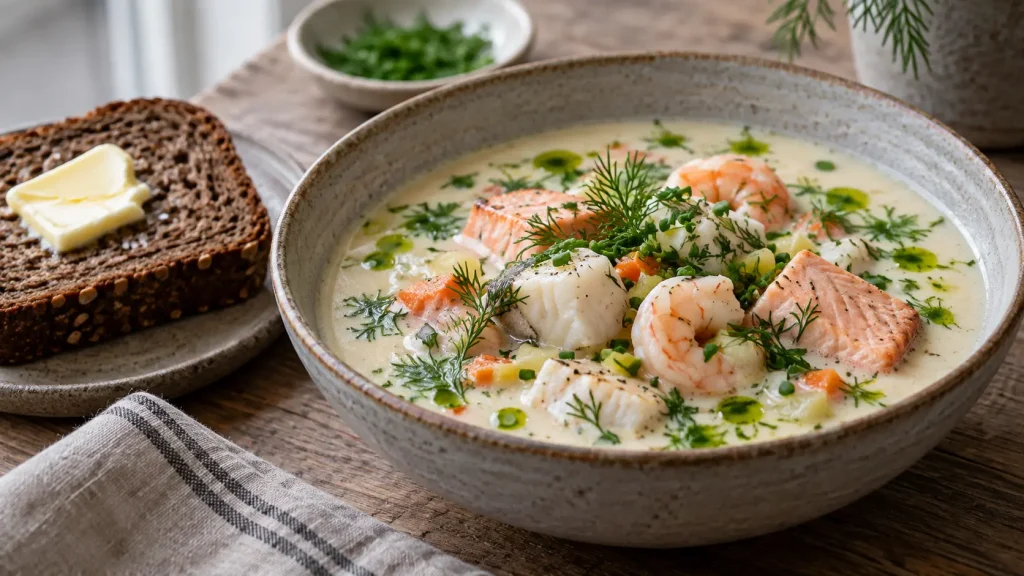
If you already love my Finnish salmon soup (lohikeitto), consider Norwegian fish soup—fiskesuppe—its slightly more extravagant coastal cousin: creamy, comforting, and filled with tender fish, vegetables, and fresh dill.
A good fiskesuppe is rich without being heavy, full of tender fish and vegetables, with just enough acidity to keep the creamy broth tasting fresh. You get natural sweetness from carrots and leek, the gentle flavor of the sea from fish stock, and a subtle sweet-sour balance from a little vinegar and sugar. Fresh dill and chives bring everything together, while the silky cream broth practically demands a piece of bread for wiping the bowl clean.
It may look rather elegant, but this is not difficult restaurant food. In fact, fiskesuppe is exactly the sort of practical cooking Scandinavians tend to do well: start with good ingredients, don’t fuss with them too much, and know when to stop cooking the fish.
And if Norwegian fish soup needed a little international validation, it got some recently. Popular food YouTuber Mark Wiens tried fiskesuppe during his trip to Oslo and loved it. Considering the man has eaten his way through some of the most intensely flavored foods on the planet, seeing him get excited about a creamy Norwegian fish soup was rather satisfying.
The secret, as he discovered, is that mild does not have to mean boring.
What Is Fiskesuppe?
Fiskesuppe simply means “fish soup” in Norwegian, and there isn’t one single recipe that every Norwegian household follows.
Versions vary from region to region and kitchen to kitchen. Some are light and brothy, while others are distinctly creamy. You might find cod, salmon, pollock, haddock, shrimp, mussels, or whatever good seafood happens to be available.
The classic creamy style usually combines fish stock, cream, vegetables, fresh fish, and herbs. Carrots and leek are particularly common, often joined by celery root, or celeriac, which adds a subtle earthy sweetness.
The combination of white fish and salmon is especially good. Cod gives the soup delicate, flaky pieces of lean fish, while salmon contributes a little richness and color. A handful of shrimp added at the end makes the whole thing feel rather luxurious for very little extra work.
This recipe stays close to that traditional character while remaining wonderfully manageable on an ordinary weeknight.
Fiskesuppe is all about balance.
The cream should soften the salty, savory fish stock without smothering it. The vegetables should still have enough texture to remind you they were once vegetables. And the fish should be cooked so gently that it separates into moist flakes when touched with a spoon.
Then comes acidity.
This part matters more than you might expect. A small splash of vinegar cuts through the cream and makes the seafood flavors seem clearer, while just a little sugar rounds everything out. The result is a subtle sweet-sour balance rather than anything sharply acidic. Dill adds that unmistakably Nordic freshness that works particularly well with salmon and shellfish.
The result is comforting but surprisingly lively.
Think chowder’s more restrained Scandinavian cousin: no potatoes, less thickness, and considerably more interest in letting the fish speak for itself.
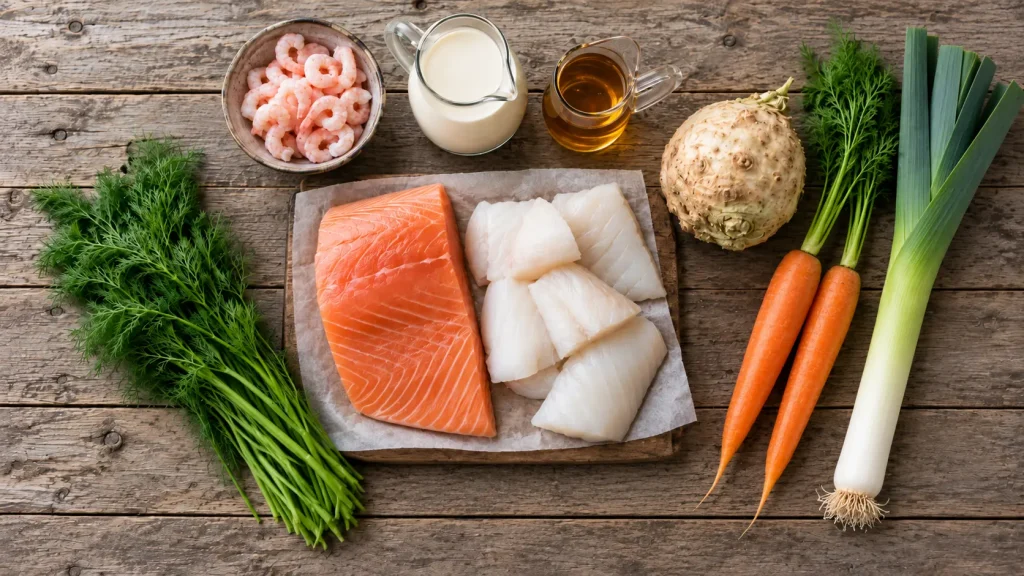
Ingredients You’ll Need for Norwegian Fish Soup
Fish
I like using both cod and salmon.
Cod, haddock, pollock, or another firm white fish works well for the white fish portion. Whatever you choose, use boneless fillets and cut them into fairly large pieces. Tiny cubes cook too quickly and are more likely to disappear into the soup.
For the salmon, skinless fillet is easiest.
Shrimp, Mussels or Clams?
Shrimp is an easy and delicious addition to fiskesuppe, but it is certainly not the only shellfish that works here.
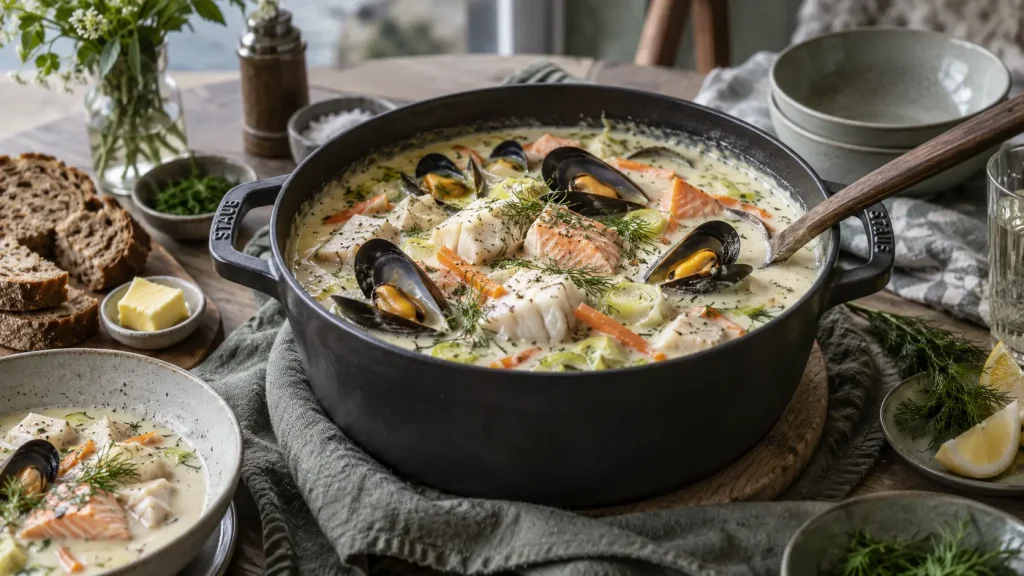
Mussels are an especially good choice and give the soup a wonderfully coastal character. Steam them separately with a small splash of water, fish stock, or dry white wine until they open, then strain the cooking liquid and add some of it to the soup for extra seafood flavor. Remove most of the mussels from their shells before adding them to the pot, although leaving a few in their shells makes the finished bowls look particularly inviting.
Clams also work well, especially small varieties. Prepare them in the same way as mussels, making sure to strain their cooking liquid carefully in case there is any sand. Because clams can be quite salty, taste the soup before adding the final seasoning.
If you prefer the simplicity of shrimp, cooked peeled shrimp are still the easiest option. Add them only during the final minute or so of cooking, just long enough to warm through.
You can also combine shellfish. Cod, salmon, shrimp, and a handful of mussels make a particularly luxurious version without changing the gentle character of the soup.
Fish Stock
Because the broth is such an important part of fiskesuppe, use the best fish or seafood stock you can reasonably find.
Homemade is lovely, certainly, but this is soup, not an examination of your moral character. A good store-bought seafood stock works perfectly well.
If your stock is strongly salted, wait until the end before adding additional salt.
Leek, Carrot and Celery Root
This trio gives the soup sweetness and structure.
Celery root, also called celeriac, is particularly good here and worth seeking out. It looks somewhat alarming in its natural state—as though a potato has had a difficult winter—but once peeled, it has a lovely mild celery flavor.
If you can’t find it, regular celery is a perfectly reasonable substitute.
Cream
Heavy cream gives fiskesuppe its smooth, luxurious texture.
This recipe also uses a little whole milk so the broth remains creamy without becoming overly rich. You want fish soup, after all, not fish swimming in Alfredo sauce.
What to Serve With Norwegian Fiskesuppe
Norwegian fish soup needs very little company.
Serve it with good dense rye bread, like Danish Rugbrød or Finnish Archipelago Bread, or Norwegian flatbrød and plenty of butter. A bowl of fiskesuppe and bread is easily substantial enough for dinner.
For a slightly more festive meal, you could begin with something small and seafood-focused, such as gravlax or Toast Skagen, before bringing the soup to the table.
And don’t save fiskesuppe exclusively for cold weather. It is certainly magnificent when there’s snow outside, but the combination of fresh fish, dill, tender vegetables, and that gentle sweet-sour finish makes it surprisingly appropriate for cooler summer evenings as well.
Perhaps fjords have no soup season.
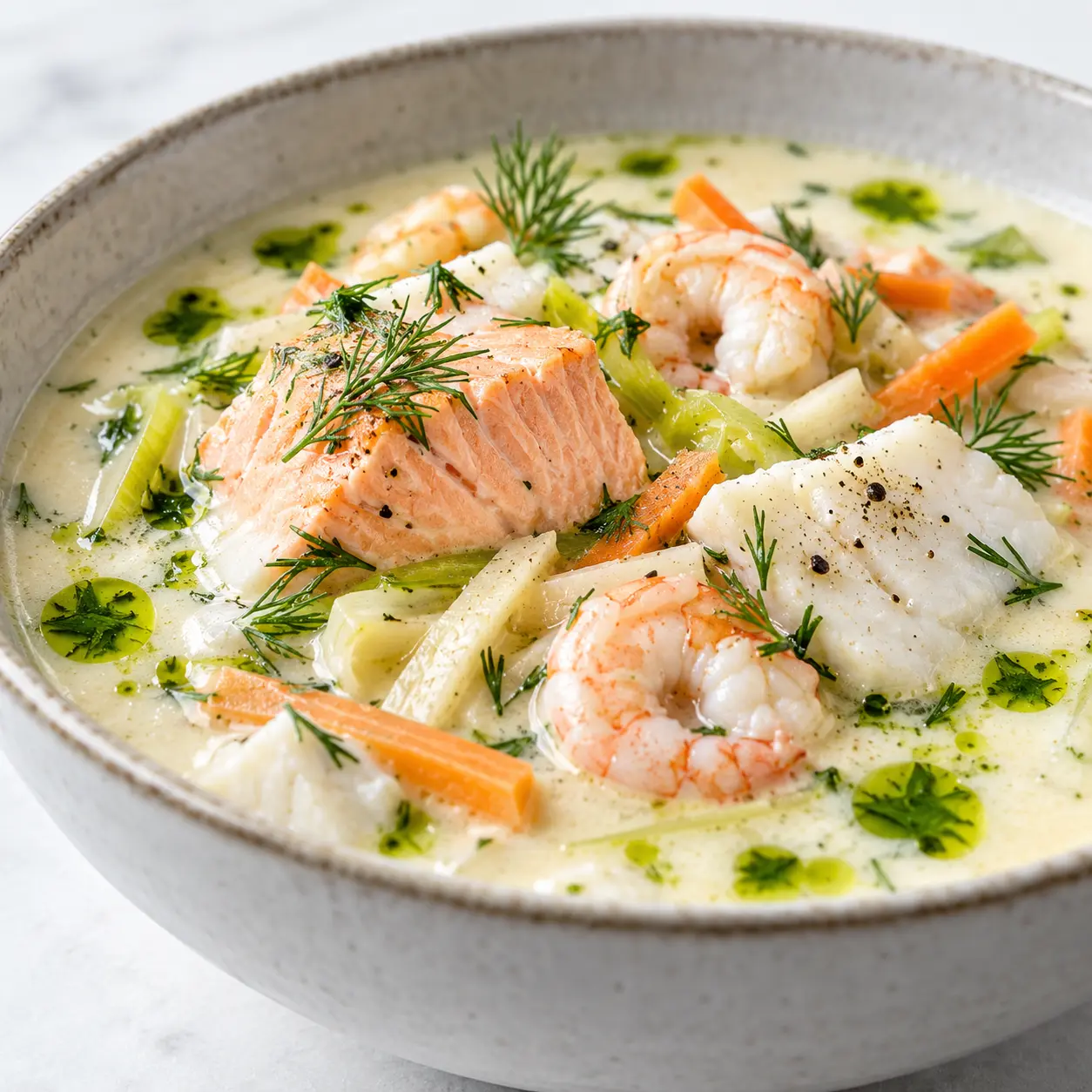
Creamy Norwegian Fish Soup (Fiskesuppe)
Ingredients
Method
- Melt the butter in a 4-quart pot over medium heat. Add the leek, carrot, and celeriac, and cook for 5 minutes, stirring, without letting them brown.
- Stir in the flour and cook for 1 minute. Gradually whisk in the stock, then the milk. Bring to a gentle simmer (about 185–195°F/85–90°C) and cook for 8–10 minutes, until the vegetables are tender.
- Lower the heat. Stir in the cream, sugar, vinegar, salt, and white pepper. Do not let the soup boil hard.
- Add the cod and salmon. Poach gently for 4–6 minutes, or until the thickest pieces reach 145°F/63°C. Add the cooked shrimp for the final 60–90 seconds.
- Fold in the dill and chives. Taste for salt and acidity, then ladle into warm bowls.




- Blend the 1 cup dill and ½ cup oil until very smooth and bright green. For a cleaner restaurant-style finish, strain it through a fine-mesh sieve; for a more rustic version, leave it unstrained.
- Drizzle about 1 teaspoon over each bowl just before serving.

Substitutions and dietary notes
Ingredient swaps
Replace cod with haddock, halibut, or pollock; swap celeriac for parsnip; or omit the shrimp entirely.
Gluten-free
Replace the flour with 1 tbsp/8 g cornstarch mixed with 1 tbsp/15 ml cold water, and simmer before adding the fish.
Dairy-free
Use olive oil, unsweetened oat milk, and oat cooking cream; add the vinegar gradually.
Allergens
The standard recipe contains fish, shellfish, dairy, and gluten.
Storage and Reheating
Refrigerate promptly and use within 3 days for best quality.
Reheat leftovers gently to 165°F/74°C.
For better freezer texture, freeze just the stock-and-vegetable base before adding the dairy and seafood.
Fiskesuppe Troubleshooting and FAQ
A hard boil after adding cream and vinegar is the likely culprit. Remove from heat and whisk gently; if badly split, remove the fish and blend a little broth. Next time, keep the finished soup below a boil and add acid gradually.
Dilute with unsalted fish stock, milk, or cream, then rebalance with a tiny splash of vinegar. Salt cannot be cooked away.
For thin soup, add a small cornstarch slurry and simmer briefly before returning fish to the pot. For thick soup, loosen with warm stock or milk.
It cannot be made raw again—sadly, soup has no undo button. Keep it in larger flakes and serve. Next time, add fish last, poach gently, and stop at 145°F/63°C.
Creamy fiskesuppe is naturally opaque. For a clear version, use a gentle simmer, skim and strain the stock, and avoid vigorous stirring.
The soup was probably boiling too vigorously or was stirred too much after the fish went in.
Cut the fish into generous pieces and poach it at a gentle simmer. Once added, stir only when necessary.
Yes, but make the broth and vegetable base ahead rather than the entire soup.
Prepare everything through the cream-and-milk stage, cool, and refrigerate. When you’re ready to eat, gently reheat the base and poach the fresh fish directly in it.
The texture will be much better.
Yes. Good-quality frozen cod, haddock, and salmon work very well.
Thaw the fish completely in the refrigerator and pat it dry before cutting it into pieces. Excess water from partially frozen fish can dilute the soup.
You can. The soup will be somewhat lighter and less silky, but still good.
Avoid prolonged boiling after adding lower-fat dairy, as it is more likely to separate.
Learn more
Skrei – the fish that built Norway | In cod we trust! (visitnorway.com)
Cook to a Safe Minimum Internal Temperature (foodsafety.gov)