
For thousands of years, the Sámi people have fed themselves from one of the harshest environments on Earth — and built a food culture of extraordinary depth, ingenuity, and meaning.
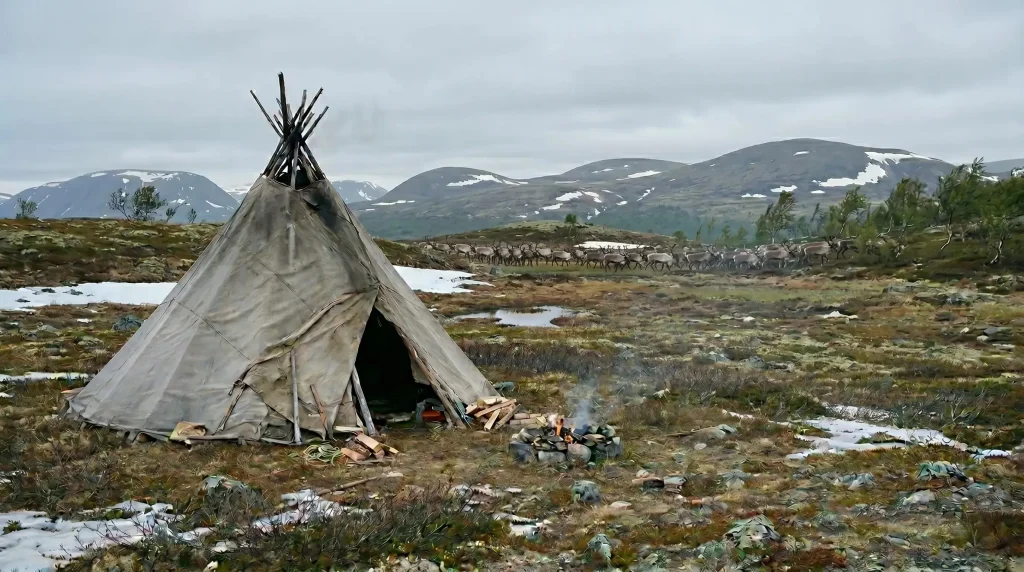
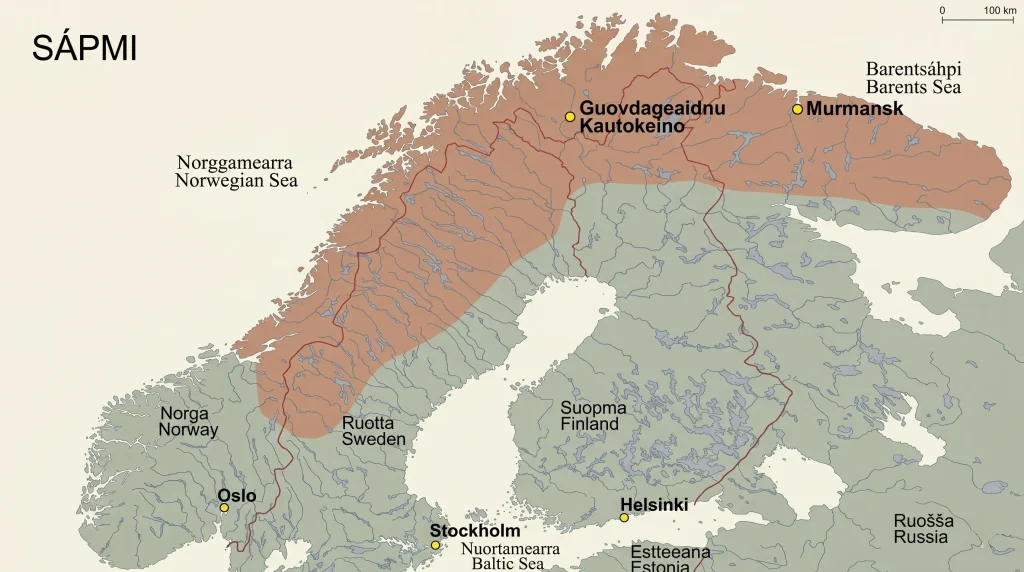
Who Are the Sámi, and Where Is Sápmi?
The Sámi are the only recognized Indigenous people of continental Europe, and their ancestral homeland — Sápmi — stretches across approximately 390,000 square kilometers of sub-Arctic and Arctic terrain, crossing the national borders of Norway, Sweden, Finland, and the Kola Peninsula in Russia.
The older term Lapp — used historically to refer to the Sámi people — is now widely regarded as pejorative; the Swedish root lapp literally means “patch” or “scrap of cloth,” a reference to the patchwork appearance of traditional Sámi clothing that was used as a term of mockery. Lapland endures as an official geographic name for regions of Finland and Sweden, but Sámi and Sápmi remain the preferred and politically accurate terms for the people and their homeland.
The Sámi are not a chapter in Nordic culinary history — they are its oldest living voice, and their food traditions are actively practiced across Sápmi today.
Eight Seasons, Not Four
Western calendars divide the year into four fixed seasons based on astronomy. The Sámi recognize eight — each defined not by dates, but by what the land and the reindeer are actually doing.
| Season | Timing | Culinary Focus |
|---|---|---|
| Dálvi | Dec–Feb | Preserved meat, bone marrow, fat — pure caloric survival |
| Giđđadálvi | Feb–Mar | Ice fishing for Arctic char and trout as preserved stocks dwindle |
| Giđđa | Apr–May | Scarcity and transition — dried meat and gáhkku sustain herders on migration; first angelica and nettle shoots emerge |
| Giđđageassi | May–Jun | First fresh fish; early wild greens and herbs |
| Geassi | Jun–Jul | Midnight sun; salmon, whitefish, open-fire grilling |
| Čakčageassi | Aug–Sept | Peak foraging — cloudberries, bilberries, mushrooms |
| Čakča | Sept–Oct | Annual reindeer slaughter; blood dishes, smoking begins |
| Čakčadálvi | Nov–Dec | Herd returns; fresh slaughter meat and hearty stews |
This calendar makes visible what Western food culture tends to obscure: that eating is inseparable from place, season, and ecological attentiveness. It also explains why Sámi food knowledge is not simply a collection of recipes — it is a complete system for reading the land.
Three Peoples, Three Kitchens
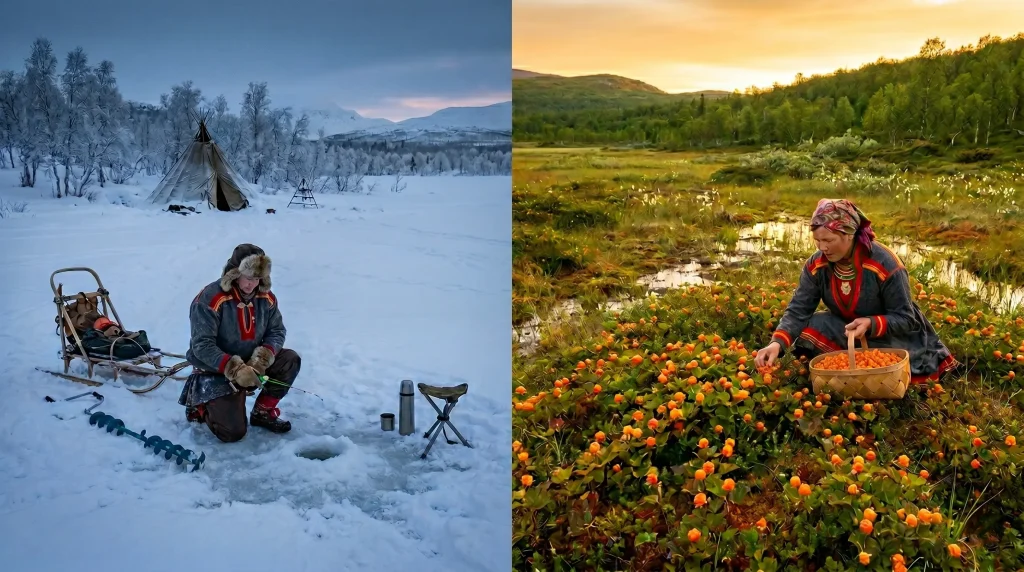
Sámi food culture is not monolithic. Historically, three distinct lifestyles evolved in response to different ecological niches, each producing a different culinary identity.
The Mountain (Inland) Sámi practiced semi-nomadic reindeer herding across the tundra, following the herds between winter forests and summer fells. Their diet was built almost entirely around reindeer — meat, blood, fat, and organs — supplemented by freshwater fishing in mountain lakes, where Arctic char was a prized staple. The demands of migration shaped their food into something lightweight and energy-dense: dried meat, smoked cuts, and portable flatbread.
The Coastal (Sea) Sámi settled in the fjord villages of Norway and the Kola Peninsula, where the sea provided cod, halibut, herring, and saithe. Fish liver and roe — consumed with fresh fish-liver oil — were daily staples that provided critical Vitamin D through the dark winter months. Traditional Sámi smoking techniques applied to ocean fish produced suovasguolle (smoked fish), a coastal cousin of the inland suovas.
The Forest Sámi occupied the boreal taiga, maintaining smaller, non-migratory reindeer herds while hunting elk, bear, and ptarmigan, and fishing rivers and lakes. They were also the primary users of the boreal forest’s botanical resources — medicinal plants, wild herbs, and the inner bark of pine trees, which became flour in times of scarcity and as a nutritional supplement year-round.
The Whole Animal Philosophy
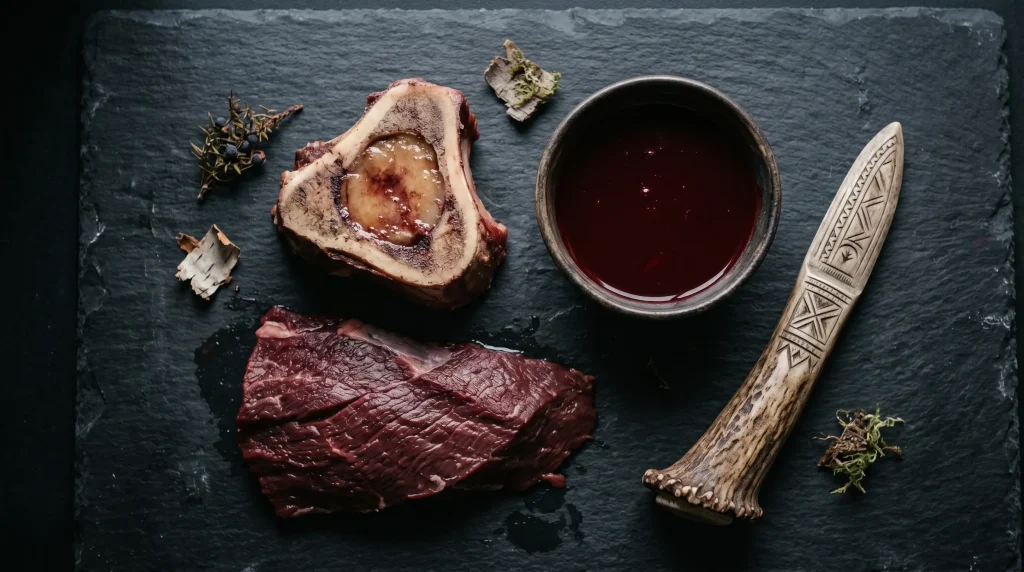
At the moral and practical center of Sámi cuisine is a principle that predates every modern sustainability movement by centuries: nothing is wasted. To discard any part of a slaughtered reindeer would be seen as a violation of the sacred reciprocal bond between the herder and the herd.
In practice, this means:
- Tongue and heart — boiled or smoked; the tongue is a prestige cut reserved for honored guests
- Bone marrow — extracted after boiling, eaten directly from the bone; exceptionally rich in fat and minerals
- Blood — carefully collected at slaughter and mixed with flour for slåbbå (blood pancakes) and mallemárffe (blood sausages); a critical source of iron and Vitamin B12
- Omentum — used as a natural casing for gurpi sausage, where it provides fat to baste the lean mince during smoking
- Hooves — historically boiled for collagen-rich broth and jelly
- Hides — tanned for clothing and shelter; antlers and bones carved into tools (duodji)
This is not frugality born of poverty. It is a sophisticated ethical and nutritional system — one that modern nose-to-tail chefs have reinvented, without always knowing that the Sámi never stopped practicing it.
The Science of Arctic Preservation
Survival in the far north required the ability to stabilize food for months without refrigeration. Sámi preservation methods are technically sophisticated and, in many cases, chemically precise.
Cold Smoking is the cornerstone technique, particularly for reindeer meat. Meat is exposed to smoke from birch or willow wood — both rich in phenolic compounds with natural antimicrobial and antioxidant properties — at temperatures below 30°C. This allows the smoke to penetrate deeply without cooking the meat, producing suovas: cold-smoked reindeer that can be stored for months and sliced thin for frying over an open fire.
Air Drying takes advantage of the cold, dry air of giđđadálvi (spring-winter). Reindeer meat is particularly well-suited to this method because of its exceptionally low fat content — approximately 2% — which prevents the oxidative rancidity that would spoil fattier meats. Strips are hung on wooden racks for several weeks, often after salting to draw out moisture through osmosis first.
Pine Bark Flour was not merely a famine food, as it’s sometimes characterized. The inner bark (phloem) of the Scots pine (Pinus sylvestris) was harvested in spring when sap was running, dried, and ground into flour, then mixed with barley flour for bread. It added significant Vitamin C, fiber, and minerals to a diet otherwise vulnerable to scurvy during the long dark months. The outer bark had to be removed entirely; its resins were bitter and would ruin the bread.
The Dishes
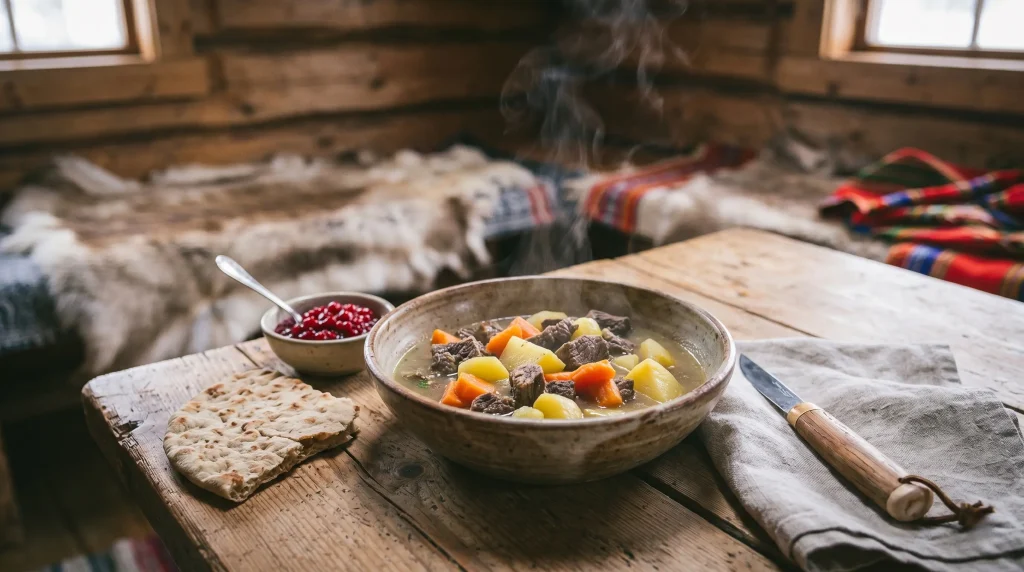
Bidos — The Celebratory Stew
Bidos is the soul dish of Sámi food culture — a slow-cooked reindeer stew served at weddings, funerals, and Sámi National Day. The ingredients are deceptively simple: bone-in reindeer meat (often including the heart), potatoes, and carrots. The depth comes from time — hours of simmering that allow the marrow and natural juices to build a rich, unctuous broth. Before the introduction of potatoes in the 18th century, it was thickened with flour or served simply with bread.
Suovas — The Smoked Staple
Suovas refers specifically to salted, cold-smoked reindeer meat — typically sliced thin and fried quickly over an open fire or hot pan, served tucked inside gáhkku with lingonberries. It is now a Slow Food Presidium product, meaning the traditional name and preparation method are protected at an international level from commercial imitation.
Gáhkku — The Universal Bread
Gáhkku is the traditional Sámi flatbread, slightly sweet and yeast-leavened, baked on a flat stone or dry frying pan. Unlike most flatbreads, it remains soft even in extreme cold — a deliberate quality that made it ideal for herders on long migrations across frozen terrain.
Gáhkku comes in variations suited to different needs. The thinner form — gárrpa — was dried and carried as a portable snack on long migrations. It is the direct ancestor of what Swedes call tunnbröd, the flatbread most international travelers encounter rolled around a filling on SAS flights without knowing they’re eating a piece of Sámi culinary history.
Tunnbröd is also the backbone of tunnbrödsrulle — the Swedish street food classic that the late Anthony Bourdain once described as “the finest and best thing I ever had in my life,” before immediately adding: “the most disgusting thing ever… and I LOVE it!”
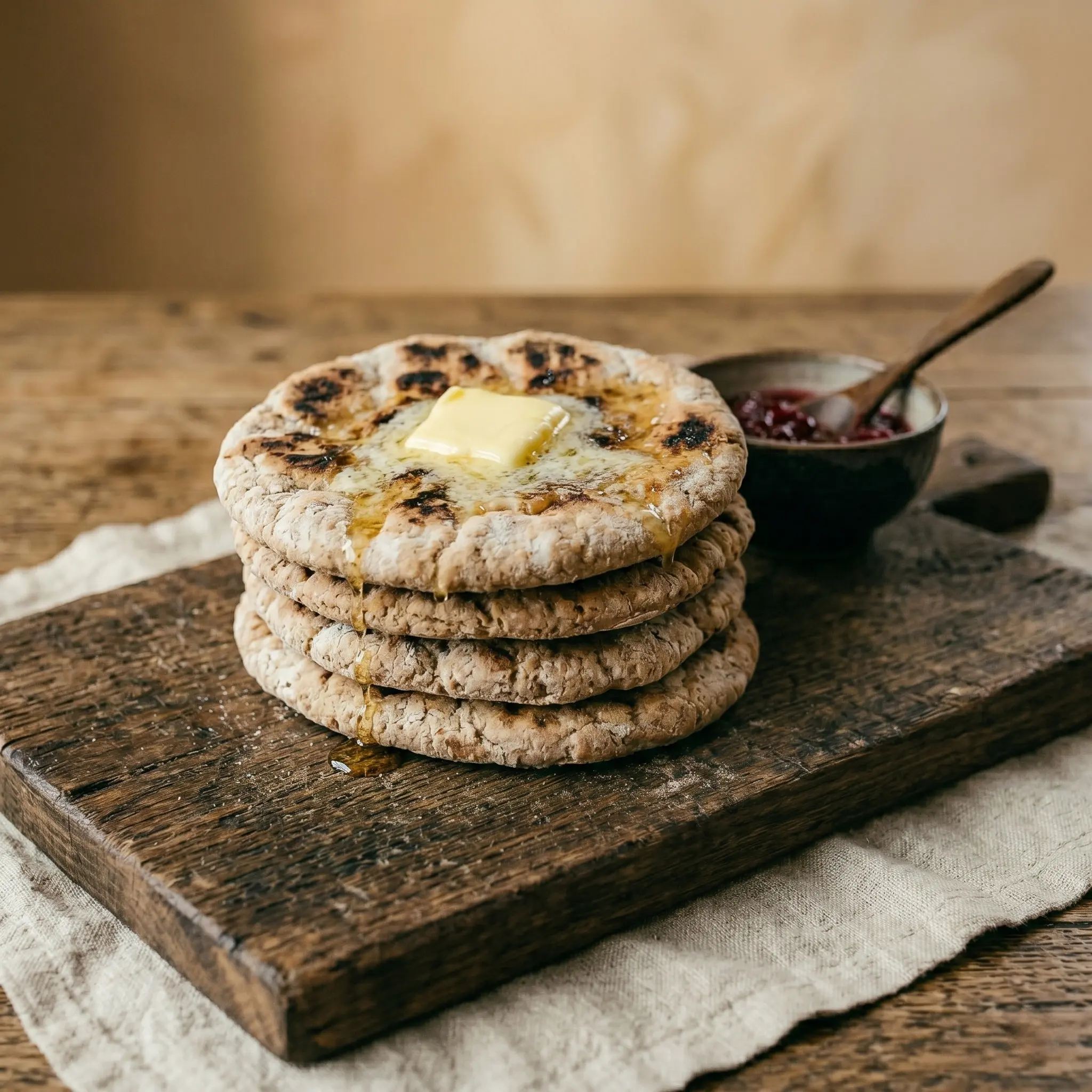
Gáhkku (Sámi Flatbread)
Ingredients
Method
- Combine flour, yeast, salt, and sugar in a bowl.
- Add warm water and butter, and mix to a soft, slightly sticky dough.
- Knead for 8–10 minutes until smooth and elastic.
- Cover and rest in a warm place for 1 hour, until doubled.
- Divide into 8 equal pieces. Roll each into a round roughly 5mm thick.
- Heat a dry cast iron pan or skillet over medium heat — no oil.
- Cook each flatbread for 3–4 minutes per side until lightly golden with dark spots.
- Keep warm wrapped in a clean cloth, or cool on a rack.
- Serve with: lingonberry jam, butter, smoked fish, or alongside a hearty stew. In the Sámi tradition, gáhkku accompanies nearly everything.
How-To: Preserving Cloudberries the Sámi Way
The cloudberry (Rubus chamaemorus) — called “the gold of the Arctic” — ripens in the bogs of Sápmi during čakčageassi (August–September), providing a vital influx of Vitamin C before the long dark season. The traditional Sámi preservation method requires no sugar, no heat, and no equipment beyond clean glass bottles.
This method works for: cloudberries, lingonberries, and crowberries. Lingonberries are the most accessible substitute if cloudberries are unavailable where you are.
What you need
- Fresh, ripe cloudberries or lingonberries
- Cold boiled water (boiled first to remove chlorine, then cooled completely)
- Clean, sterilized glass bottles with tight lids
Learn the traditional Sámi method for preserving cloudberries and lingonberries using only cold boiled water and glass bottles — no sugar, no heat, no special equipment.
- Sterilize your bottles
Submerge in boiling water for 10 minutes. Allow to cool and air dry.
- Sort the berries
Remove any damaged, unripe, or moldy berries. Skip rinsing them under the tap; tap water carries chlorine and bacteria that can compromise the preservation before the seal is in place. The cold boiled water added in the next step is your controlled, clean liquid — that’s the only water that should touch the berries.
- Pack the bottles
Fill each bottle firmly with berries, leaving about 1 inch or 2cm headspace at the top.
- Cover with water
Pour cooled boiled water over the berries until fully submerged, tapping the bottle to release air pockets.
- Seal immediately
Cap tightly and store in a cool, dark place (a cellar or the back of a refrigerator is ideal).
- Wait
The berries are ready to use after 2 weeks and will keep for up to a year in cool conditions.
Why it works: Cloudberries and lingonberries contain naturally high levels of benzoic acid — a mild natural preservative that inhibits yeast and bacterial growth without any added sugar or heat treatment. The cold boiled water creates an oxygen-reduced environment that further slows spoilage.
Use the preserved berries as a sauce for game, stirred into porridge, on flatbread with butter, or alongside roasted root vegetables.
Joik: When Food Becomes Song
No account of Sámi food culture is complete without joik — one of Europe’s oldest continuous vocal traditions. A joik is not a song about something; it is the sonic essence of the thing itself. To joik a friend, a mountain, or a reindeer herd is to conjure its presence through melody and rhythm.
During communal meals inside the lavvu (the traditional Sámi tent), joiking served as a bridge between the physical act of eating and the spiritual world. A host might joik the animal being consumed — not as performance, but as acknowledgment, ensuring that the animal’s spirit was recognized and respected. For centuries, Christian missionaries labeled joiking sinful and worked to suppress it. It survived anyway, a testament to its centrality in Sámi identity.
The “slowness” of Sámi food — the weeks of drying meat, the hours of simmering stew, the communal preparation — mirrors the unhurried quality of joik itself. Both are practices that insist on presence.
Land, Climate, and the Politics of Food
The future of Sámi food is inseparable from politics. The ability to produce traditional food depends entirely on access to the grazing lands, clean waters, and ancestral territories where that food has always come from.
Across the four Sápmi countries, the legal framework for reindeer herding varies considerably. In Sweden, herding is organized into 51 samebyar (Sámi villages), but herders routinely face court battles to defend grazing rights against private landowners and forestry companies — with the legal burden of proof placed on the Sámi to demonstrate historical usage of land they have intentionally left unscarred.
The accelerating global transition to renewable energy has introduced what Sámi scholars now call “green colonialism”: wind farms and lithium mines installed on Sámi lands to fuel the rest of the world’s sustainability goals. Lichen pastures — critical winter forage for reindeer — have declined by as much as 70% in some areas.
Climate change compounds this. Erratic freeze-thaw cycles create reavvi — impenetrable ice crusts over the lichen — forcing herders to buy industrial fodder. This not only places a heavy financial burden on herding families but also alters the flavor and nutritional profile of the reindeer meat itself, changing the very taste of a culture.
The Modern Revival
Despite these pressures, a generation of Sámi chefs, entrepreneurs, and educators is actively reclaiming their culinary heritage — on their own terms.
Huuva Hideaway in Swedish Sápmi, led by Pia and Henry Huuva, offers “educational dining” experiences that center traditional meals within storytelling and music, functioning as a cultural hub rather than simply a restaurant. The Slow Food Foundation for Biodiversity has included Suovas in its Presidium program, protecting the traditional preparation method from commercial imitation globally. The Sámi University of Applied Sciences (Sámi allaskuvla) in Kautokeino documents traditional food knowledge and trains a new generation of Sámi cultural leaders.
Sámi organizations have also created the Sámi Duodji and Sámi Made trademarks, helping consumers identify authentic products and ensuring that the economic benefit of Sámi cultural heritage flows back to Sámi communities — not to tourism companies appropriating their aesthetics.
The path forward is one that honors the ancestors while adapting to the 21st century — ensuring that the oldest food culture in Northern Europe continues to be heard, and tasted, for generations to come.
Want to experience Sámi food culture firsthand? Seek out Sámi-led experiences across Sápmi — from lavvu dinners in Swedish Lapland to guided foraging in northern Norway. The most authentic taste of this cuisine comes with the story still attached.